?

Hydroponic 3D Models

Find the best Hydroponic 3D Models, free download in STL, FBX, GLB, OBJ, 3MF, USDZ for 3D modeling and creation in Blender, 3D printing, game developing, animation, eCommerce, AR/VR and etc. Generated by Tripo AI 3D Generator.

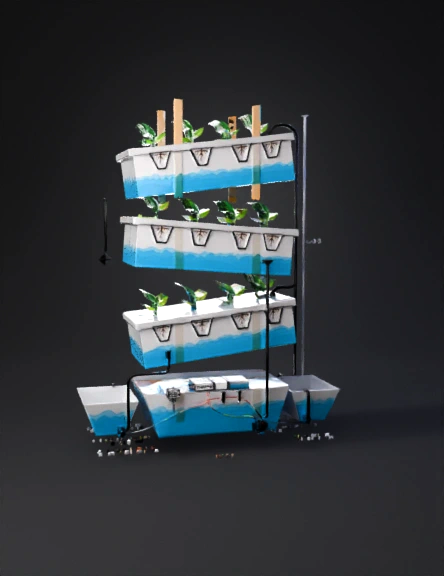
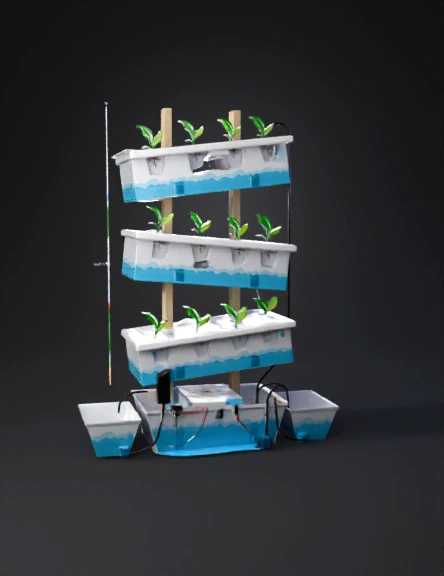
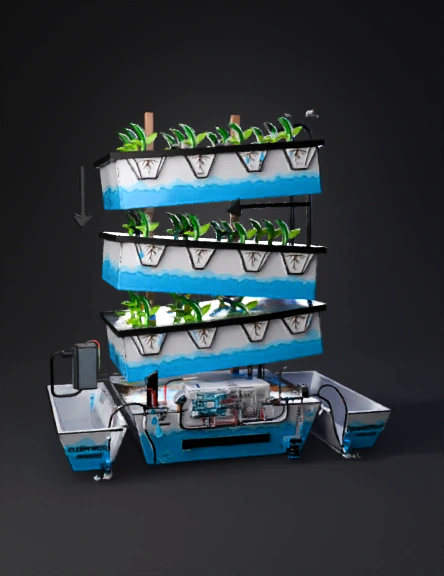
Create a detailed 3D model of a hydroponic NFT (Nutrient Film Technique) system with specific parameters:
1. Reservoir/Tank: 400mm x 300mm x 250mm (LxWxH), opaque plastic
2. Two PVC pipes: 110mm diameter, 500mm length, mounted at 2% slope
3. Net pots: 80mm diameter, placed every 200mm along pipes (3 pots per pipe)
4. Support structure: 40x40mm aluminum profile frame
5. Water pump: cylindrical, 50mm diameter x 80mm height
6. PVC hoses: 12mm diameter for supply and drainage
7. Electronic components:
   - ESP32 development board
   - pH sensor probe
   - EC/TDS sensor probe
   - DS18B20 waterproof temperature sensor
   - Two SG90 servo motors for dosing
- All parts dimensionally accurate
- Show water flow path with arrows
- Include mounting brackets and hardware
- Cross-section view to show internal components
- Professional engineering visualization
- High detail, precise lines, professional diagram
Style: technical drawing, blueprint, vector illustration, 8k detail
Anonymous1761850845
A rectagulaire greenhouse of a hydroponic system
Anonymous1761043591
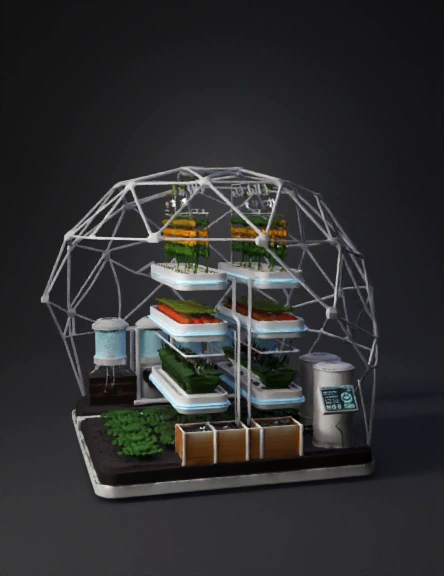
A greenhouse of a hydroponic system
Anonymous1761043591
a hothouse with hydroponic systeme
Anonymous1761043591
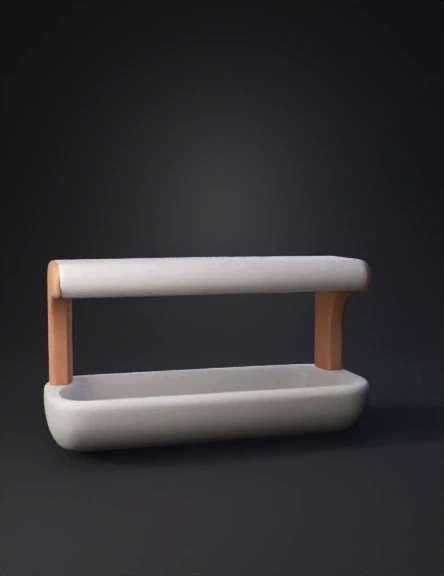
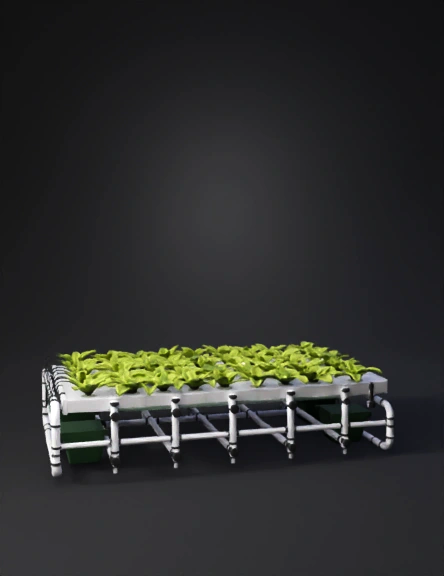
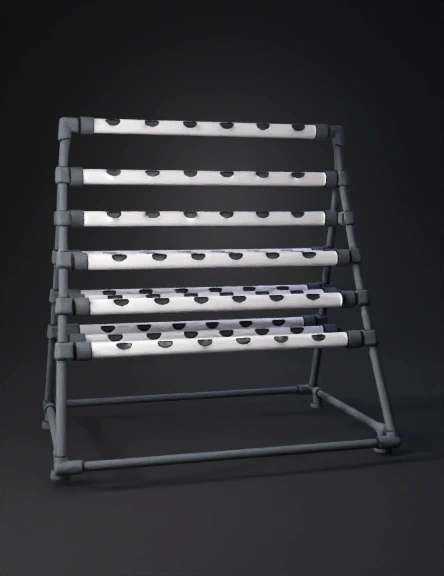
Create a clean, minimal 3D white model of a horizontal hydroponic system, inspired by NFT (Nutrient Film Technique) greenhouse farming setup.

→ Structure:
- A rectangular frame made of steel or aluminum pipes.
- Overall size approximately 3.0 m long × 1.5 m wide × 1.2 m tall.
- The upper surface supports parallel hydroponic channels.
- Each channel is a long rectangular pipe (100 mm wide × 80 mm tall × 3 m long).
- There are about 12–15 channels arranged side by side with 100 mm spacing.
- Each channel has evenly spaced planting holes (~100 mm diameter) along the top for small plants.
- The channels are slightly sloped (~2–3 degrees) to allow nutrient solution flow from one end to the other.
- At the lower end, a drain pipe collects the nutrient water into a rectangular tank (nutrient reservoir).
- The reservoir box is about 0.6 m × 0.4 m × 0.4 m, located under the frame.
- A small pipe pumps nutrient solution from the reservoir back to the upper end of the channels, forming a closed loop.

→ Geometry and components:
- Frame made of tubular pipes (diameter 40 mm) forming a simple rectangular scaffold.
- Channels rest on horizontal beams at three levels: bottom (reservoir), mid-frame, and top tray support.
- Include one or two small vertical riser pipes connecting the reservoir to the top channels.
- Show the thin “nutrient film” flowing through the channels as a shallow groove (can be left as a small gap line).

→ View composition:
- Main axonometric or isometric view showing the entire system from above (bird’s-eye view).
- Secondary side section showing the water flow cycle:
  - Arrows (if possible) to indicate “nutrient drainage,” “nutrient return,” and “nutrient reservoir.”
  - Three stacked levels to suggest multi-tier systems.
- Optional: an additional close-up of one channel showing planting holes and internal water layer.

→ Style:
- Use pure white or light gray matte materials, no color or texture.
- Background neutral light gray, soft daylight.
- Clean studio lighting emphasizing form and modular rhythm.
- No vegetation, only planting holes as geometry.

→ Dimensions (metric):
- Channel length: 3.0 m
- Channel width: 0.1 m
- Channel height: 0.08 m
- Frame height: 1.2 m
- Spacing between channels: 0.1 m
- Reservoir: 0.6 × 0.4 × 0.4 m
- Channel slope: 2–3°

→ Output:
- White architectural model emphasizing structure and water circulation logic.
- Include both perspective (bird’s-eye) and section views.
Anonymous1757926457
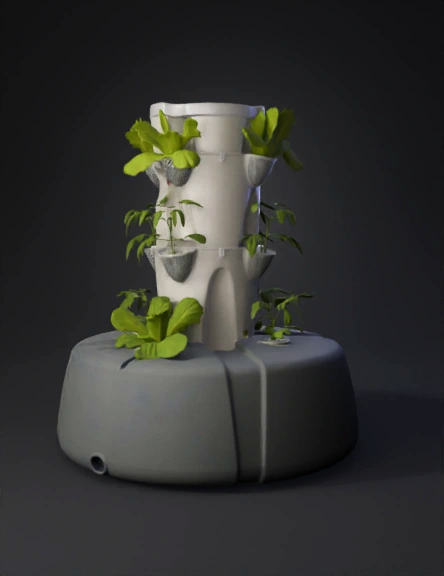
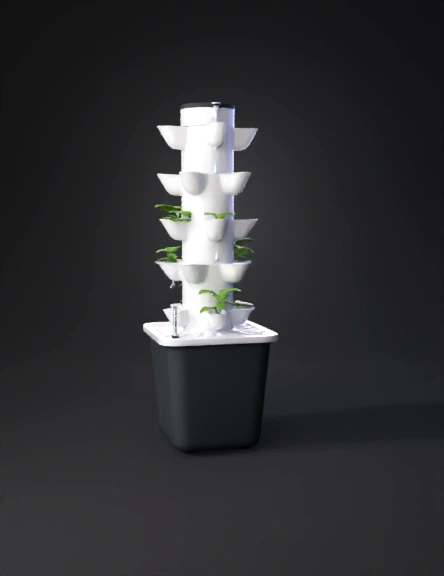
Create a clean 3D white model of a modular vertical hydroponic farming system inspired by Israel Pavilion Expo Milano 2015 technology.

→ Model concept:
- A repeating array of vertical hydroponic columns standing on a shared base structure.
- Each column is a hollow cylindrical pipe about 200 mm in diameter and 2.5 meters tall.
- Along each column, attach a spiral sequence of planting trays or pockets.
- Each tray is semi-circular or quarter-cylinder shaped, projecting outward about 250 mm, and spaced vertically every 250 mm.
- The trays alternate orientation around the cylinder in a spiral pattern (rotation 45–60 degrees per level).
- The system contains about 8–10 planting trays per column.
- Each column connects at the top to a horizontal blue irrigation pipe and at the bottom to a rectangular base water reservoir.
- Columns are arranged in a slanted grid wall: approximately 5 rows deep × 10 columns wide, creating a porous vertical farming screen.
- Pipes and structure are connected by thin supporting rods and frames.

→ Geometry and material:
- Use smooth, matte white or light gray material for all components (no textures, no colors).
- Keep all edges crisp and clean; focus on simple geometry and modular repetition.
- Highlight the rhythm, hierarchy, and alignment of the repeating tower units.
- Emphasize proportions and spacing—show clear vertical rhythm and horizontal alignment.

→ Composition and camera:
- Present one full array view from an oblique 45° angle.
- Include one isolated single column as a close-up beside the array.
- Neutral background, soft white lighting, no color shadows.
- No vegetation textures — pure model geometry only.

→ Dimensions and scale:
- Column height ~2.5 m
- Column diameter ~0.2 m
- Tray projection ~0.25 m
- Vertical spacing between trays ~0.25 m
- Base slab thickness ~0.3 m
- Grid array size ~10 columns × 5 rows (~4 m deep × 8 m wide)

→ Output:
- Simple architectural white model suitable for presentation board.
- Focus on modularity, form logic, and water flow system geometry.
Anonymous1757926457
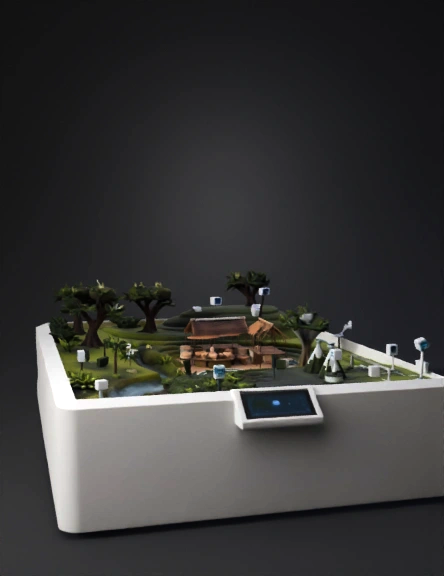
Ecosistema conceptual de Europa, luna de Júpiter. Muestra una maqueta tridimensional con suelo helado y grietas que revelan un océano subterráneo brillante y líquido. En el centro, una base científica con cultivos hidropónicos iluminados por luces verdes y azules. Incluye organismos extremófilos bioluminiscentes, como bacterias, algas y criaturas pequeñas adaptadas al frío. Agrega una atmósfera tenue con tonos azulados, reflejos en el hielo y un fondo que muestre el espacio exterior. Escena detallada, estilo realista y científica, iluminación suave.
Anonymous1760751769
Anonymous1725713685
一、屋顶基础环境(场景基底)
屋顶结构:平屋顶,主体为钢筋混凝土材质(厚度 15cm),表面铺设灰色防水卷材(纹理细腻,反光率低),边缘设 1.2 米高防护栏(铝合金材质,浅灰色,栏杆间距 10cm,带弧形扶手),护栏西侧留 1 米宽出入口(配银色折叠门,关闭时与护栏平齐)。
地面处理:防水卷材上铺设浅灰色环氧地坪(表面微糙,防打滑),沿护栏内侧留 20cm 宽排水槽(U 型,深 5cm,槽内贴黑色防滑条),排水槽末端连接屋顶排水口(圆形,直径 10cm,带金属滤网)。
周边环境:屋顶东侧、北侧为建筑墙体(米白色涂料,无窗户),西侧、南侧开阔(可看到远处 3 层红砖建筑,天空为淡蓝色,带少量白色絮状云);墙体底部设 1.5 米高白色储物柜(铁皮材质,带玻璃门,内放园艺工具),柜顶摆 3 盆多肉植物(陶瓷花盆,直径 15cm,颜色分别为浅粉、浅绿、浅黄)。
二、水培模块化种植系统(核心功能区)
1. 模块布局与尺寸
整体排列:系统位于屋顶中央区域(距东侧墙体 2 米、距南侧护栏 1.5 米),呈 3 列 ×4 排矩阵式摆放,列间距 1.2 米(人行通道),排间距 1 米(维护通道),通道地面贴黄色实线标识(宽 5cm,线条平直)。
单模块规格:每个种植模块为长方体结构(长 1.2m× 宽 0.6m× 高 0.4m),外壳为食品级 PP 塑料(浅灰色,表面有细微磨砂纹理),模块顶部边缘设 5cm 宽挡水沿(防止水溢出),正面贴蓝色标签(印 “水培模块 - 01~12” 编号)。
2. 模块内部结构
种植层:模块上半部分为种植槽(深 15cm),槽内分 6 个独立定植格(每个长 18cm× 宽 15cm,格间用 3cm 高 PP 塑料隔板分隔),每个定植格放 1 个白色海绵定植篮(直径 12cm,海绵呈蜂窝状,包裹生菜幼苗根部,叶片露出篮外 3~5cm,呈鲜绿色)。
水循环层:模块下半部分为储水腔(深 20cm,容积约 144L),腔底设黑色 PVC 进水管(直径 2cm,管口朝左,水流呈细柱状)和出水管(直径 3cm,管口朝右,带网状滤网);储水腔内装透明水位观察窗(长 10cm× 高 8cm,位于模块正面右侧,窗内标红色最低水位线和绿色正常水位线)。
3. 系统配套设备
主水箱:位于种植矩阵西北侧(距最近模块 1 米),不锈钢材质(银色,长 1.5m× 宽 0.8m× 高 1m),水箱顶部设黑色进水口(带浮球阀,自动补水),侧面下部接 3 根分水管(PVC 材质,白色,直径 4cm,分别连接 3 列种植模块的进水管),水箱外壁贴温度显示屏(黑色边框,白色数字,显示水温 18~22℃)。
水循环泵:安装在主水箱内部左侧(功率 300W,银色金属外壳,带静音减震垫),通过白色软管连接分水管,泵体顶部设红色启停按钮;每个种植模块出水管通过黑色软管汇总到主水箱右侧回水口(带蓝色过滤器,过滤杂质)。
补光设备:每个种植模块正上方 1.2 米处悬挂 1 根 LED 补光条(长 1.1m,白色外壳,发出暖白光,色温 5000K),补光条通过银色金属支架固定在屋顶钢架(钢架为 L 型,高 2.5 米,固定在屋顶混凝土预埋件上),支架上贴黑色线槽(隐藏电线)。
三、AI 控制系统(智能配套)
1. 硬件布局
控制箱:位于主水箱北侧(距水箱 0.5 米,落地安装),黑色冷轧钢板外壳(长 60cm× 宽 40cm× 高 80cm,表面贴银色散热格栅),正面设 10 英寸触控屏(显示系统参数:水温、pH 值、EC 值、光照时长),屏下方有 3 个实体按键(绿色 “运行”、黄色 “调试”、红色 “紧急停止”),箱顶装红色故障指示灯(闪烁频率 1 次 / 秒)。
传感器部署:
每个种植模块储水腔内放 1 个 pH 传感器(银色探头,线缆从模块背面小孔引出,沿地面线槽连接控制箱);
主水箱内放 1 个 EC 传感器(黑色探头,固定在水箱内壁,距底部 20cm);
补光条支架上装 1 个光照传感器(白色半球形,直径 5cm,朝向正南,检测自然光强度);
屋顶东南侧护栏上装 1 个温湿度传感器(灰色长方体,长 8cm× 宽 5cm× 高 3cm,检测环境温湿度)。
2. 功能联动设计
AI 逻辑可视化:触控屏显示实时数据曲线(绿色水温曲线、蓝色 pH 曲线、紫色 EC 曲线),当数据超阈值(如水温>25℃、pH<5.5)时,屏幕对应区域变红,同时控制箱发出蜂鸣提示,自动启动水箱内 1.5kW 不锈钢加热棒(降温时启动)或营养液添加泵(pH 异常时添加调节剂,泵体位于控制箱右侧,银色,体积约 1L);
光照联动:光照传感器检测到自然光强度<3000lux 时,AI 自动开启补光条(亮度随光照强度调节,最低 30% 功率,最高 100%),并在触控屏显示 “补光模式开启” 提示框;
远程接口:控制箱背面设网线接口和 WiFi 天线(黑色,长 15cm),可通过手机 APP 远程查看数据、手动切换模式(屏幕右上角显示 WiFi 信号图标,满格为 4 格)。
四、细节补充(场景质感)
材质质感:PP 塑料模块表面有轻微反光(反射天空淡蓝色),不锈钢设备有金属光泽(水箱反射周围模块影子),环氧地坪有哑光质感(通道处有轻微脚印纹理,模拟日常维护痕迹);
动态元素:水循环泵运行时,主水箱水面有轻微波纹,种植模块内水流从进水管流出时呈细流状(流速缓慢,无飞溅),补光条开启时在模块表面形成淡白色光斑;
氛围点缀:通道地面放 1 个浅灰色塑料水桶(半装清水,桶壁有少量水珠),控制箱旁摆 1 盆薄荷(白色塑料盆,枝叶垂出盆外,带淡淡绿色阴影),护栏上挂 2 个银色金属挂钩(空挂,用于悬挂水管)。
Anonymous1757481195
Anonymous1760131526
snow falls on the roof of the house, it turns into water, it flows through the downpipe into the filter and flows out of the orange pipe from there. annimation
Anonymous1759949800
haz el modelo 3d
Anonymous1758686795
数字化产品自动浇水补光盆栽
Anonymous1758870988
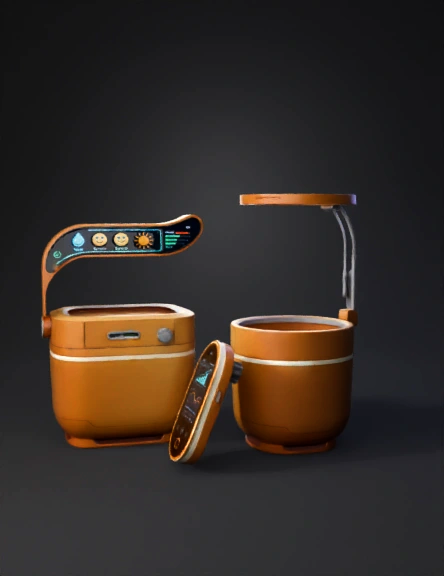
A simple self-watering planter for hydroponics, 3d model, low-poly style. It consists of two stackable cylindrical parts: 1. A solid, opaque basin as a water reservoir with a small fill hole on the side. 2. A transparent cup with a funnel-shaped bottom and a central hole. A thick cotton wick rope passes through the hole. The top cup is filled with hydrogel beads and a small plant. Exploded view to show assembly.
Anonymous1753192463
Anonymous1776464297
Anonymous1776381043
Anonymous1776155522
Enter invite code to get credits!