3D Workspace
Home
Assets
Affiliate Program
Creator Program
Sign up/Log in
View Plans
DCC Bridge
gabrielmkt.supradiesel
12-04 12:23
Model Name
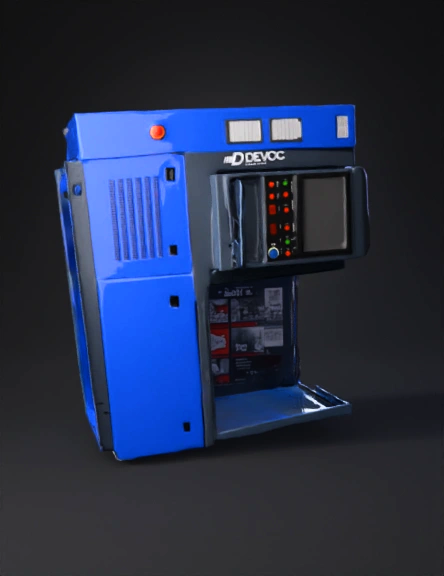
industrial cnc machine 3d model
Tags
cnc machine
equipment
industrial cnc machine
machine
machine realistic
machine rendering
machine rendering realistic
realistic
rendering
rendering realistic
Input
Prompt
1 — General Overview Industrial bench-top testing equipment with a closed steel cabinet structure, featuring blue (outer panels) and dark-gray (control section) electrostatic coating. The unit sits on a rigid metal base concealed by exterior panels and is currently placed on a wooden pallet for transport. It includes a front control console (screen/buttons) and a right-side test chamber with a hinged door and glass/acrylic window. The “DEVOC” logo appears prominently on the lower-right front panel and vertically on the central left column. 2 — Approximate Dimensions (for initial 3D scaling) Note: Dimensions below are ESTIMATED from the photo. Replace with precise measurements when available. Total height: ≈ 1500–1700 mm Total width: ≈ 1400–1700 mm Depth: ≈ 700–900 mm Console (screen) height from floor: ≈ 900–1100 mm Sheet-metal thickness: 1.5–3 mm (folded steel panels) All modeling should be done at real-world scale (1:1) in millimeters. 3 — External Structure (Face-by-Face Description) Front View Lower front panel: Large blue section with a rectangular ventilation grille (thin horizontal openings). Two separate lower access doors with small recessed finger grips. Central vertical column (dark gray): “DEVOC” letters applied vertically in white. This column houses the control console. Control console: Rectangular monitor with dark-gray frame and glossy glass surface. Button panel below the monitor: Green and red round push buttons, small red LED numeric displays, indicator lights, and a large emergency stop mushroom button (yellow base, red top). Pull-out tray/mini-desk containing a mouse/USB area. Right test-chamber door: Dark-gray metallic frame. Large central glass/acrylic window. Hinged on the right side (door is open in the photo). Rubber gasket around the door edges. Left Side Large blue panel with industrial safety stickers (yellow/black rectangles). A big rotary emergency/power switch (red handle, yellow square base). Small data/specification plate at the upper section. Top View Slightly angled front section. Seam lines suggest removable top cover with concealed screws. Base / Bottom Internal metal supports and mounting rails; sitting on a pallet in the photo. Likely includes adjustable feet or anchor points. 4 — Test Chamber (Interior Details Visible in the Photo) Door assembly: metal frame, glass center, latch mechanism, vertical hinge. Internal working platform: A flat red metal plate used for mounting injectors/pumps. Rotating test plate / fixture system: Circular or partially circular plate with multiple clamp points. Connected to hoses and actuators. Cylinders/solenoids: Small silver pneumatic/hydraulic actuators visible on upper right area. Tubing system: Combination of steel pipes and flexible hoses (rubber/PTFE) with threaded fittings. Sensors / transducers: Small boxed modules with cables routed toward the electronics compartment. Guides & supports: Metal profiles, angled brackets, and bolted fixtures. 5 — Panels, Doors & Mechanical Features Panel corners: 3–6 mm filleted radius (typical folded steel). Gaps between panels: 5–8 mm spacing. Screw types: Philips or hex, typically around access openings. Ventilation grille: stamped/laser-cut metal sheet. Paint: Electrostatic coating, glossy for blue, matte/semi-gloss for gray. 6 — Recommended Materials & PBR Textures Outer panels (blue): Painted steel — Roughness: medium-low Metallic: 0–0.1 Console frame (dark gray): Matte painted steel. Window frame: Steel or anodized aluminum. Glass: IOR ≈ 1.5 Subtle reflections and fingerprints for realism. Push buttons: glossy plastic. Hoses: medium-rough rubber, metallic clamps. Screws/bolts: stainless steel (Metallic = 1.0). Decals (logo, warnings): Vinyl stickers with slight edge thickness via normal map. 7 — Recommended Mesh Organization (Naming Convention) Main groups: base_frame panel_left, panel_right, panel_front_lower, panel_front_upper console_frame monitor_glass, monitor_frame button_array, led_display, e_stop_mushroom test_door_frame, test_door_glass test_table rotor_plate, fixture_clamps internal_cylinders, transducers hose_*, fitting_* vent_grille decals_devoc, safety_labels Recommended folder/collection structure: exterior, control_console, test_chamber, plumbing, electronics, decals. 8 — Topology & LOD Standards LOD0 (High): Detailed bevels, screw heads, hose geometry, internal parts. LOD1 (Medium): Simplified buttons, no small mechanical details. LOD2 (Low): Panels simplified into cubes with normal-mapped details. Topology guide: Use quads whenever possible. Apply bevels (2–4 segments) on all visible edges for realistic highlights. Use curve/spline systems for hoses. 9 — Functional/Mechanical Requirements for the 3D Model Door must rotate around a hinge pivot (0°–90°). Pull-out tray must slide forward. Rotating plate should have pivot at center for accurate simulation. Base should include mounting holes (M8) for anchoring. 10 — UV & Texturing Notes Unwrap each external panel individually (clean rectangular islands). Use 2K–4K textures for decals and labels. Ventilation grilles can be modeled or normal-mapped depending on LOD. Add light wear (AO, cavity, subtle roughness variation). 11 — Additional Photos/Measurements Needed for Full Accuracy Please send if possible: Closeup of the monitor (front & side). High-resolution photo of button panel with text/labels. Photo of the data/specification plate. Three internal photos of the test chamber (front, right side, top). Closeups of hoses and fittings. Key measurements: Total width, height, depth Console height Emergency stop button diameter Test chamber door width/height Rear-panel photos. 12 — Delivery Recommendations (for the 3D Artist) Export as: FBX (hierarchy + pivots) OBJ (geometry + UVs) STL only for 3D printing Include PBR textures: Albedo Normal Roughness Metallic AO Provide an optional preview scene with neutral HDRI lighting. 13 — Notes Internal mechanical components appear partially visible but require closeup images for accurate modeling. Naming convention and modular structure help with revisions. For manufacturing use, real-world tolerances must be added (chamfers, fillets, real screw threads). Light weathering improves realism for rendering.
Detailed Info
Related Models
Enter invite code
Enter invite code to get credits!
 gabrielmkt.supradiesel


 gabrielmkt.supradiesel