3D Workspace
Home
Assets
Affiliate Program
Creator Program
Sign up/Log in
View Plans
DCC Bridge
Anonymous1762742097
11-30 12:18
Model Name
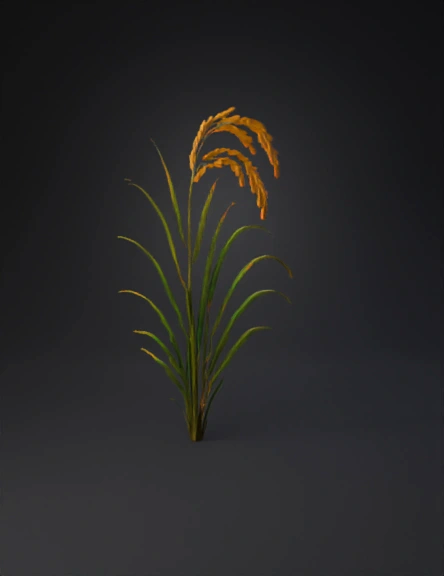
rice plant 3d model
Tags
nature environment
nature environment realistic
nature environment rendering
nature environment rendering realistic
realistic
rendering
rendering realistic
rice plant
Input
Prompt
A fully mature rice plant (Oryza sativa) at harvest stage, modeled with complete botanical accuracy and extreme photorealistic detail. The plant consists of multiple tillers growing from a single root crown. The root system forms a dense fibrous cluster, light brown to tan, with thin branching roots and fine root hairs. The root crown is compact, slightly swollen, and naturally dry. Stems (culms) are hollow, cylindrical, smooth, with distinct nodes and internodes. Lower internodes are pale yellow-green transitioning to medium green higher up. Nodes are thicker ring-like bands with subtle horizontal wrinkles and natural color variation. Vertical fiber textures are visible along the culm surface. Leaf sheaths wrap tightly around each node, pale green to yellowish with gentle ridges. At the junction of sheath and blade, include anatomically correct ligules (thin membranous, translucent, pale white-green) and small auricles (two claw-like pale-green projections hugging the stem). Leaf blades are long, narrow, lanceolate, with sharp pointed tips. They show a strong central midrib (lighter green) and parallel venation. Leaves curve downward naturally with slight twists, small brown spots, and dryness at edges. Colors shift from deep green on upper leaves to yellow-green on older lower leaves. Each tiller ends with a fully mature, heavy, drooping rice panicle. The main panicle axis (rachis) is thin, pale yellow-green, with fine vertical striations. Primary branches extend outward and downward; secondary pedicels hold individual spikelets. The panicle must show layered structure: upper branches slightly upright, middle branches outward, lower branches strongly drooping due to grain weight. Spikelets are densely packed but individually distinguishable. Each spikelet contains a single grain enclosed by lemma and palea (the husk). Husks are elongated, golden-yellow, matte, with fine parallel veins and a faint keel line. At the base of each spikelet, include two tiny, pale papery glumes. Some spikelets may have short brown awns at the tips. Each rice grain is elongated, oval, 6–10 mm in real scale, plump, tapered slightly at the tip, golden-yellow to amber, with subtle surface texture. Hundreds of grains must be individually visible, separated, and hanging naturally to create a heavy, ripe appearance. The grain attachment point (callus) is a tiny darker yellow spot at the base. Color palette: – Leaves: deep green (#3A6B2D → lighter #8ABF5A) – Stems: green transitioning to pale yellow (#C4C26D) – Panicle branches: yellow-green (#D6D982) – Grains: golden (#E3B549 → #D8A432) with subtle chromatic variation – Roots: brown (#9C784A) The overall plant should appear fully mature, dry, heavy with golden grains, and true to real Southeast Asian rice at harvest time. All anatomical structures must be present: roots, root crown, culms, nodes, internodes, leaf sheaths, ligules, auricles, leaf blades, midribs, panicle rachis, primary and secondary branches, pedicels, spikelets, lemma, palea, glumes, awns (optional), and individual grains. Materials should include natural translucency in leaves, matte texture for husks, subtle roughness variations, and realistic dried coloration. The final model should be suitable for close-up 3D rendering, PBR workflows, and scientific-level accuracy.
Detailed Info
Related Models
Enter invite code
Enter invite code to get credits!