3D Workspace
Home
Assets
Affiliate Program
Sign up/Log in
?
Upgrade
DCC Bridge
Anonymous1759484179
02-12 13:49
Model Name
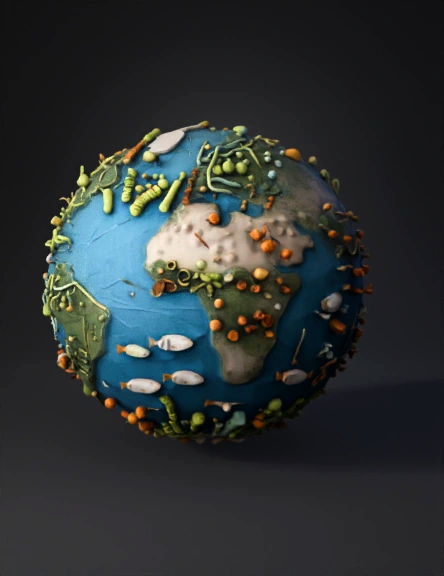
earth globe 3d model
Tags
nature & environment
rendering
realistic
Prompt
A hive mind is not just a metaphor. Across life on Earth, certain species have evolved to operate as a single, distributed intelligence. Each agent — whether a microbe, insect, or vertebrate — follows local rules, yet together they produce decisions, patterns, and behaviors no single individual could achieve alone. Microbial Beginnings: At the smallest scale, bacteria demonstrate the simplest form of a hive mind. Through chemical quorum sensing, individual cells release and detect signals that trigger population-wide behaviors: biofilm formation, virulence, or movement. One bacterium is powerless; together, millions act with astonishing coordination. Next, slime molds take it a step further. A single cell can roam independently, but under stress or starvation, thousands aggregate, forming a temporary, cooperative organism capable of seeking nutrients with collective logic. Here, the mind is not in one cell but emerges in the interaction of many. Insects and Structured Societies: Ants, termites, bees, and wasps exemplify the classic hive mind. Each member has specialized roles — foraging, defending, reproducing — yet the colony as a whole acts with a purpose beyond the individual. Pheromones, vibrations, and chemical trails allow instant communication and coordination. A single ant cannot comprehend the colony’s goal, yet the colony functions as if it were a single thinking entity. Flocks, Schools, and Swarms: Vertebrates also display hive-like behaviors. Fish in schools, birds in massive flocks, and insects in swarms rely on rapid perception and reaction to neighbors. Global patterns — like murmurations of starlings or shoaling of sardines — emerge from simple rules: align, avoid collision, and stay close. Individually, they cannot plan these formations; collectively, they move with fluid intelligence. The Human Threshold Humans, in contrast, are only proto-hive. Our cognitive abilities allow for abstract thought, language, and technology, but our minds remain largely individual. What would it mean if humans achieved a true hive mind? Imagine: networks of brains connected not by physical pheromones or proximity, but through symbolic, cultural, and technological channels. Decisions made collectively, memory distributed across populations, culture as a shared consciousness. The internet, social networks, and global communication may already hint at this possibility — a faint echo of an intelligence that is not mine, nor yours, but ours. The Threshold of Numbers Across species, hive minds appear to function best when population sizes are above a critical threshold. Bacteria only act when quorum is reached. Birds move as flocks when numbers are sufficient to create emergent patterns. Could humans, if population density and connectivity reached a certain point, trigger a similar collective cognition? A hypothetical global human hive mind may be limited not by individual capability, but by numbers, interaction, and shared focus.
Detailed Info
Related Models
Enter invite code
Enter invite code to get credits!