3D Workspace
Home
Assets
Affiliate Program
Sign up/Log in
?
Upgrade
DCC Bridge
Anonymous1758767684
09-29 14:51
Model Name
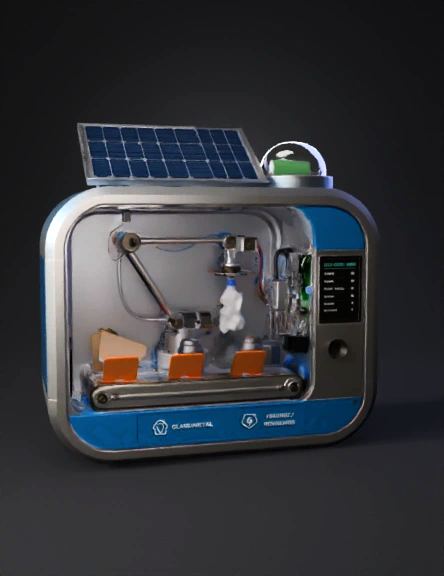
solar-powered sorting kiosk 3d model
Tags
machine
machine realistic
machine rendering
machine rendering realistic
realistic
rendering
rendering realistic
solar
sorting machine
Prompt
A compact kiosk/unit sits at a society collection point. Residents dump mixed small items into a top hopper. Inside, a small robotic arm (metal-rod frame, 4–6 DOF) uses a vacuum suction end-effector to pick individual items from the hopper, presents them to an on-board camera/AI classifier, and places them on a short conveyor that passes under sorting gates (servo-actuated flaps). Based on the AI classification (plastic, paper, metal, organic, hazardous), the conveyor or gates route each item into the correct bin. System is powered primarily by a solar panel + battery so it can operate during daylight and limited hours without grid power. 2 — Key design concepts (worded, high level) Robotic arm & frame: Lightweight but rigid metal-rod frame (aluminium or mild steel rods/tubes) with bolted joints. Use simple revolute joints (bearings + bolts) and 4–6 actuators (mix of high-torque hobby servos or small stepper/gear motors) to give reach and height needed to access hopper and conveyor. Metal rods make the structure cheap and easy to fabricate/repair. End effector (suction): A small vacuum pump (diaphragm or mini piston) creating suction at a soft silicone suction cup. Suction is good for bottles, cans, and many small items; pair with a simple mechanical gripper as fallback for bulky/flat items if needed. Item handling flow: Hopper → arm picks item → camera on the arm near the end-effector (stable distance) → classifier decides category → arm places item on conveyor → conveyor moves item under sorting gates → servo flaps push/drop item into the right bin. Inside segregation mechanism: Short conveyor with 3–5 compartments or continuous belt plus multiple gates. Gates are controlled by servos; small sensors (IR breakbeam or proximity) confirm item location and trigger gate actions. AI & compute: On-board single-board computer (Raspberry Pi 4 or similar) runs a small image classifier (lightweight CNN or MobileNet) on the camera frames. Optionally use a Coral USB Accelerator later if you need faster inference. The Pi also runs the high-level scheduler that sequences arm picks and sorting. Sensors & feedback: Camera for vision, an ultrasonic or IR sensor for hopper depth detection, load cell or simple current sensing to detect grasp success, magnetic/inductive sensor to identify metal when vision is ambiguous. Power & solar: Solar panel + MPPT/charge controller + battery sized to run typical daily cycles. System is designed to be low-power — arm moves are brief; vacuum pump runs only during pick attempts. 3 — Mechanical design specifics Frame: 25–30 mm diameter aluminium/mild steel rods for verticals and booms, joined with T-junction brackets and gussets. Height ~0.7–1.0 m, reach ~0.5–0.8 m to access hopper and conveyor. Use threaded rod + nuts for adjustable joints. Arm DOF: Base rotation (yaw) — 1 Shoulder (lift) — 1 Elbow (reach) — 1 Wrist pitch — 1 Wrist roll (optional) — 1 Suction control (vacuum on/off) — valve or pump on/off Use quality metal servo horns / couplers at joints for strength. End-effector: Soft silicone suction cup mounted on a lightweight aluminum plate. Include a small valve to quickly release suction for drop. Add a tiny camera mounting near the cup with stable bracket. Internal sorter: 40–60 cm short conveyor built with PVC sheet and small DC motor + roller. Sorting gates: 3–5 servo-actuated flaps (each flap diverts into segregated bin). 4 — Electronics & control Main compute: Raspberry Pi 4 (4GB recommended) for camera capture, inference, and UI. Use Python (OpenCV + TensorFlow Lite) for inference. A microcontroller (ESP32/Arduino) handles real-time servo PWM and vacuum pump relay to keep power/IO simple. Motor/servo control: Dedicated servo controller (I2C PWM board) or MOSFET H-bridge for any DC motors. Relay or MOSFET to switch vacuum pump. Sensors: Pi camera (or USB camera), IR breakbeam sensors on conveyor positions, ultrasonic for hopper level, load cell module to detect pick success, one inductive sensor for metal detection if needed. UI & connectivity: Small touch LCD or use the Pi’s web UI for status + manual override. Wi-Fi for remote monitoring/logs. Optionally SMS/WhatsApp alerts via gateway. 5 — Software & AI flow Training: Collect dataset of items commonly found in your society (plastic bottles, wrappers, paper, tins, glass shards, organic waste). Train a small MobileNet or EfficientNet-Lite model, quantize to TensorFlow Lite to run on Pi. Runtime loop: Hopper sensor says items present. Arm moves, suction ON, lift. Load-cell/current check → confirm pick. If failed, retry N times. Hold item in front of camera, capture image(s) from multiple angles (rotate wrist slightly if needed). Run classifier → category + confidence. If low confidence, use fallback sensors (inductive for metal) or route to “uncertain” bin for human inspection. Move to conveyor drop point and release suction. Sensor triggers conveyor to move item to sorting gates. When at gate position, actuate appropriate flap to drop item into the bin. Log result. Update local statistics and optionally sync with cloud or society management dashboard. Operational policies: Skip items that are too large — prompt staff to handle; isolate hazardous (sharp batteries, syringes) into a sealed bin flagged for safe collection.
Detailed Info
Related Models
Enter invite code
Enter invite code to get credits!
 Anonymous1758767684


 Anonymous1758767684