3D Workspace
Home
Assets
Affiliate Program
Creator Program
Sign up/Log in
View Plans
DCC Bridge
Anonymous1772988367
03-08 16:51
Model Name
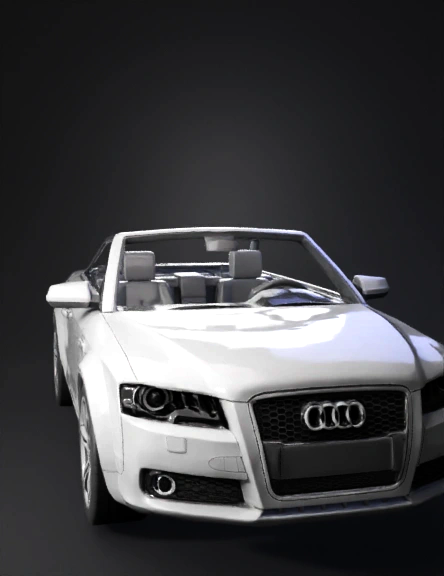
convertible car 3d model
Tags
convertible
convertible car
realistic
rendering
rendering realistic
vehicle
vehicle realistic
vehicle rendering
vehicle rendering realistic
Prompt
Create a highly accurate 3D printable model of a 2006 Audi A4 Cabriolet (B7 generation). The model must represent the full exterior body and structural underside of the vehicle with realistic proportions and recognizable design features. The final model must be optimized for FDM 3D printing and exported as a single watertight STL mesh. GENERAL STYLE Realistic car body proportions with simplified but clearly recognizable details suitable for 3D printing. The model should retain the distinctive shape and design language of the B7 Audi A4 Cabriolet while avoiding fragile geometry. TARGET SCALE The model should be designed to match LEGO Speed Champions scale. Target dimensions: Length: approximately 180 mm Width: approximately 68 mm Height: approximately 45 mm Maintain correct proportional scaling so the vehicle silhouette matches the real car. BODY GEOMETRY Accurately reproduce the key exterior design features of the B7 Audi A4 Cabriolet including: • Audi single-frame front grille • hood contours and crease lines • accurate front bumper profile • realistic headlight housing shapes • smooth curved fenders and wheel arches • door outlines and panel seam lines • side mirrors thickened for print durability • convertible roof folded behind rear seats • windshield frame and A-pillars • trunk lid shape and rear bumper profile • taillight shapes integrated into the rear body • realistic side skirt contour Wheel arches must be proportioned for toy-scale wheels similar to LEGO Speed Champions vehicles. SURFACE QUALITY • smooth continuous surfaces • consistent curvature • no blocky approximations • medium-high polygon density • clean edge flow along body panels • subtle panel gap lines UNDERBODY DETAIL (HIGH PRIORITY) The underside of the model must include recognizable automotive structural elements instead of a flat surface. Include simplified but identifiable versions of: • front subframe crossmember • engine cradle structure • transmission tunnel • floor pan with reinforcement ribs • chassis rails • fuel tank located near the rear axle • exhaust system running from front to rear • catalytic converter • mid-pipe exhaust section • rear muffler housing • dual exhaust tips exiting rear bumper • differential housing • rear suspension mounting structure • basic suspension arm shapes • heat shielding plates • underbody aerodynamic panels All underbody components must be connected to the main body to avoid floating geometry. PRINTABILITY REQUIREMENTS The model must be optimized for FDM printing on consumer printers. Requirements: • single solid manifold mesh • watertight geometry • no non-manifold edges • no internal geometry • minimum wall thickness: 2 mm • minimum detail thickness: 1 mm • avoid extremely thin parts • avoid unsupported floating elements • strengthen mirrors and small protrusions • underside components must be integrated structurally • geometry should slice cleanly in common slicers PRINTING ORIENTATION The model should be designed so it can print with the underside facing the build plate. Prefer gentle slopes rather than extreme overhangs to reduce support requirements. GEOMETRY QUALITY • consistent polygon density • clean topology • no overlapping surfaces • no intersecting faces • avoid unnecessary micro-detail that cannot print • ensure smooth wheel arch curves • maintain sharp edges where appropriate LEVEL OF DETAIL Prioritize accurate vehicle silhouette and body lines first, then add underbody structural elements with simplified mechanical forms that remain printable at the specified scale. OUTPUT FORMAT Export the final model as a single STL mesh suitable for slicing and 3D printing.
Detailed Info
Related Models
Enter invite code
Enter invite code to get credits!
 Anonymous1772988367


 Anonymous1772988367