3D Workspace
Home
Assets
Affiliate Program
Sign up/Log in
?
Upgrade
DCC Bridge
Anonymous1763139375
11-14 17:47
Model Name
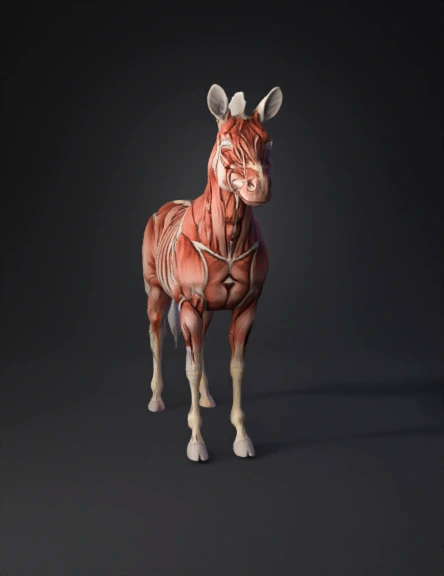
horse musculature 3d model
Tags
creatures animals
creatures animals realistic
creatures animals rendering
creatures animals rendering realistic
horse anatomy
muscle
realistic
rendering
rendering realistic
Prompt
Create a highly detailed, anatomically accurate 3D model of an adult zebra (Equus quagga), showing all muscle groups and body mass as a solid form. The model should exclude bones entirely. No skin, no fur, no external features. Only muscular mass, tendons, and connective tissue shapes visible. The body should appear fully “filled out” and realistic, in neutral standing posture. 1. Overall Structure Base proportions must reflect a normal adult zebra. Muscles should flow naturally around each other, creating the full volume of the body. Avoid showing the skeleton; muscles should form the shape of the zebra’s torso, limbs, neck, and head naturally. 2. Head & Neck Muscles Include all jaw, facial, and neck muscles: Masseter, temporalis, pterygoids Sternocephalicus, brachiocephalicus, splenius, trapezius Neck muscles should have elongated and slightly curved volumes, connecting head to shoulder smoothly. Jaw and throat areas should have realistic thickness and definition. 3. Torso & Back Muscles Model full chest, abdomen, and back muscles: Latissimus dorsi, longissimus dorsi, spinalis Serratus ventralis, external oblique, rectus abdominis Muscle mass should create realistic volume and bulges, wrapping around invisible ribcage and spine. Smooth transitions between deep and superficial muscle layers. 4. Forelimb Muscles Shoulder and upper limb: deltoid, supraspinatus, infraspinatus, subscapularis, biceps brachii, triceps brachii Forearm: flexor and extensor muscle groups Muscles should taper naturally toward the hoof, forming the cylindrical shape of the limbs. 5. Hindlimb Muscles Include gluteals, quadriceps, hamstrings (biceps femoris, semimembranosus, semitendinosus) Lower limb: gastrocnemius, digital flexors and extensors Muscle mass should form the full shape of the leg, tapering realistically toward the hoof. 6. Tail Muscles Include small musculature around the tail base, smoothly fading distally. Distal tail mostly thin muscular mass. 7. Material & Texture Muscle tissue: reddish to dark red, slightly varied for realism Tendons/connective tissue: pale, semi-translucent Smooth but slightly fibrous texture to indicate fibers No external fur or skin covering 8. Pose Neutral standing position: Head forward, neck slightly curved naturally Legs straight, weight evenly distributed Tail relaxed downwards Muscles should reflect natural tension and compression in standing posture 9. Model Requirements Fully volumetric muscles (no hollow shells) Anatomically accurate shapes and fiber directions Suitable for high-resolution close-up rendering Optionally, can be animated for movement without showing bones
Detailed Info
Related Models
Enter invite code
Enter invite code to get credits!
 Anonymous1763139375


 Anonymous1763139375