3D Workspace
Home
Assets
Affiliate Program
Creator Program
Sign up/Log in
View Plans
DCC Bridge
fejan70429
10-31 17:36
Model Name
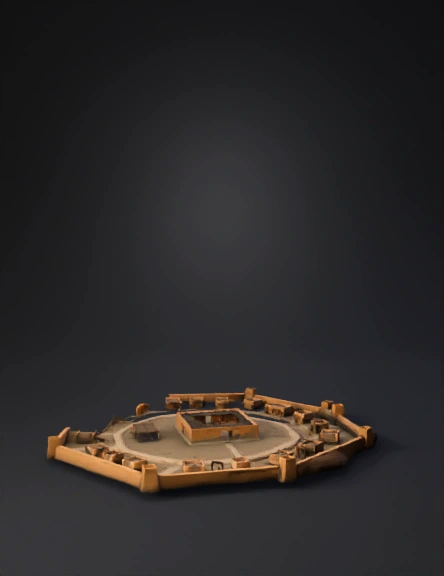
ancient desert city 3d model
Tags
architecture
architecture realistic
architecture rendering
architecture rendering realistic
desert city
realistic
rendering
rendering realistic
Prompt
"Create a highly detailed and historically accurate 3D reconstruction of the city of Madinah (Yathrib) during the time of Prophet Muhammad (PBUH). The model should accurately represent the full city layout, including buildings, streets, markets, houses, defensive walls, and the surrounding geography. Focus on realistic scale, materials, lighting, and textures to make the environment appear alive and authentic. --- 1. City Overview The city should be modeled as a medium-sized desert settlement enclosed by simple mudbrick and stone defensive walls, roughly 1.5 km by 1 km in size. The city’s centerpiece is the Prophet’s Mosque (Al-Masjid an-Nabawi) located near the eastern-central area. The urban layout is organic, with winding narrow dirt streets, small courtyards, and houses arranged in clusters. Surrounding the city are palm groves, farmlands, and wells, with Mount Uhud visible to the north as a massive rocky landmark. --- 2. The Prophet’s Mosque (Al-Masjid an-Nabawi) The central and most sacred structure. Rectangular in shape: approximately 50 meters long and 50 meters wide (the early mosque before expansions). Walls made of mudbrick, supported by palm trunks, and roofed with palm leaves and clay. Open courtyard in the middle, surrounded by a shaded prayer area (Riwaq) made from palm trunks and fronds. The Qibla wall faces south (towards Makkah). The Suffah area (a shaded platform for the poor and travelers) is along the northwestern wall. Lighting is natural, and the ground is covered with sand or small pebbles. --- 3. The Prophet’s Houses The Prophet’s private quarters are attached directly to the eastern side of the mosque. Each house is made from mudbrick and palm materials, measuring around 6 x 6 meters, with 1–2 small rooms and a small open courtyard. Each room has a simple wooden door and no decoration. Houses of the Prophet’s wives (Aisha, Hafsa, Sawda, etc.) are lined along the eastern wall of the mosque, in a row formation. These rooms are separated by narrow passageways, with each house accessible directly from the mosque. --- 4. House of Fatimah (RA) and Ali (RA) Located next to the Prophet’s houses, slightly southeast of the mosque. The house is small (about 8 x 8 meters), built from mudbrick with a tiny courtyard, one main room, and a small kitchen/storage area. The door opens toward the mosque’s eastern side. This house is close enough that voices from the mosque could be heard clearly inside. --- 5. Houses of the Companions (Sahabah) Surrounding the mosque in concentric clusters, roughly 50–150 meters away. Each house is a small mudbrick dwelling, typically 5–8 meters wide, with flat roofs and inner courtyards shaded by palm trees. Examples of notable houses: House of Abu Bakr (RA): west of the mosque, near one of the main paths leading to the marketplace. House of Umar ibn Al-Khattab (RA): north of the mosque, near residential clusters. House of Uthman ibn Affan (RA): southeast of the mosque, near the outer street. House of Hamzah ibn Abdul-Muttalib (RA): closer to the northern gate, near farmland areas. Houses are grouped by tribe or family, forming small community blocks connected by narrow alleys (1–2 meters wide). --- 6. The Marketplace (Souq of Madinah) Located northwest of the mosque, approximately 200–250 meters away. An open-air market surrounded by small rectangular stalls (2x3 meters each) made from wood and palm leaves. The market sells dates, wheat, fabrics, animal products, and tools. Ground covered with sand, and wooden poles hold up shaded canopies. No permanent stone buildings — everything is light and movable to reflect simplicity. The market serves as both an economic and social hub for residents and travelers. --- 7. Streets and Pathways Streets are narrow and winding, averaging 1.5–3 meters wide. Made of compacted sand and small stones, sometimes lined with mudbrick walls. Main roads connect the mosque with the marketplace, city gates, and residential clusters. Smaller footpaths weave between houses and gardens. No organized grid, but natural, organic paths shaped by daily foot traffic. --- 8. Defensive Walls and Gates The city is enclosed by low defensive walls (about 2.5–3 meters high) made from mud and stones. Four main gates: Southern Gate (Qibla Gate) → Road to Makkah. Northern Gate (Uhud Gate) → Toward Mount Uhud. Eastern Gate (Baqi’ Gate) → Leads to Baqi’ Cemetery. Western Gate (Market Gate) → Leads to the main trade routes. Small watchtowers or raised platforms every few hundred meters. --- 9. Gardens, Wells, and Farms Surrounding the city are lush palm groves and small farms irrigated by wells. Each farm area includes date palms, wheat fields, and vegetable plots. Famous wells: Bir Rumah (Uthman’s Well) – north of the city, providing fresh water. Bir Ghars – east of the city, known for its sweet water. Small mud irrigation channels connect wells to farms. The farmland extends outward, forming a green belt around the city, in contrast to the desert beyond. --- 10. Mount Uhud and Surrounding Terrain Mount Uhud is located 4 km north of the city, depicted as a large, rocky mountain range. The Battle of Uhud site can be marked with a simple, flat plain near the base of the mountain. The terrain around Madinah is rocky and semi-arid, with scattered vegetation and volcanic basalt stones. --- 11. Environmental and Lighting Details Use warm desert lighting, with sunrise and sunset hues reflecting the natural desert atmosphere. Textures should include: Rough mudbrick for walls Dry earth for streets Palm trunks and leaves for roofs and shading Sandy terrain with light vegetation for the outskirts The overall atmosphere should feel peaceful, humble, and community-oriented, reflecting the simplicity of life during the Prophet’s era. --- 12. Scale & Accuracy Notes All buildings should be true to historical scale — no exaggeration or modern design. Streets and houses should feel naturally formed, not grid-planned. The mosque and houses of the Prophet should be visibly distinct but still simple and modest. Maintain proportional distances: Mosque → Market: ~250m Mosque → City Wall: ~400–600m Market → Northern Gate: ~150–200m --- Goal The 3D environment should reflect the social, architectural, and spiritual life of Madinah during the Prophet’s lifetime — a living, breathing city of faith, simplicity, and human connection. It should look authentic enough to feel like a real ancient city brought back to life.
Detailed Info
Related Models
Enter invite code
Enter invite code to get credits!
 fejan70429


 fejan70429