3D Workspace
Home
Assets
Affiliate Program
Sign up/Log in
?
Upgrade
DCC Bridge
Anonymous1768586182
01-23 15:49
Model Name
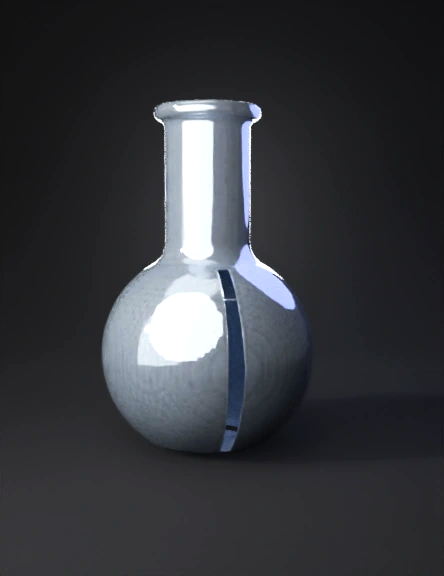
round bottom flask 3d model
Tags
props
rendering
realistic
Prompt
Create a highly realistic, scientifically accurate 3D model of laboratory glassware, inspired by a round bottom flask (RBF) that has been cut cleanly and precisely along a horizontal plane at its exact midpoint, and then opened toward the viewer, similar to the way a coconut appears when broken cleanly into two halves and presented facing forward. The final model must clearly communicate the idea of intentional separation, not damage or shattering. The flask should look as if it was perfectly sliced using a precision tool, preserving symmetry, smoothness, and structural clarity. 🔹 Overall Composition and Orientation The scene should consist of two distinct parts of the same round bottom flask: Upper half of the flask, including: The cylindrical neck The curved upper portion of the spherical body Lower half of the flask, consisting of: The lower spherical bowl A flat, circular cut opening at the top Both halves must be aligned along the same vertical axis and positioned so that: The open cut surfaces face directly toward the viewer The separation feels intentional and balanced The upper half is slightly elevated above the lower half, maintaining visual clarity between the two The orientation should resemble a front-facing exploded view, where the viewer can clearly see inside the flask, similar to a cross-sectional scientific visualization, but without internal slicing beyond the horizontal cut. 🔹 Cutting Plane and Geometry Accuracy The flask must be cut using a perfectly horizontal plane passing through the geometric center of the spherical body (not the neck). Key cutting requirements: The cut must be exactly 50% of the spherical body height The cutting plane must be mathematically flat and uniform The cut edge must be smooth, circular, and clean No jagged edges, cracks, or irregularities The wall thickness must remain uniform and clearly visible at the cut boundary The result should resemble a precision-machined section, not a broken object. 🔹 Shape and Proportions The round bottom flask should follow standard laboratory proportions, including: A near-perfect spherical lower body A smoothly transitioning shoulder from sphere to neck A vertical cylindrical neck with a slight lip or rim at the opening No flat base (true round bottom design) The geometry should feel scientifically correct, suitable for educational, research, or pharmaceutical visualization. 🔹 Glass Material and Surface Properties The flask must be modeled as transparent borosilicate glass, commonly used in laboratory equipment. Material characteristics: High transparency with subtle natural tint (very light blue or neutral) Realistic light refraction and internal distortion Accurate reflection highlights along curved edges Slight thickness visible through refraction Smooth, polished glass surface (not frosted, not matte) At the cut surface, the glass edge should: Appear slightly thicker Clearly define the inner and outer surfaces Optionally have a faint frosted or matte edge only at the cut to enhance visibility (optional, not mandatory) 🔹 Interior Visibility Because the halves are facing the viewer, the inner cavity of the flask must be clearly visible. Interior requirements: Hollow interior consistent with wall thickness No internal artifacts or geometry errors Smooth interior curvature matching the exterior form Interior glass surface should reflect and refract light realistically This interior visibility is critical — the viewer must immediately understand that this is a hollow laboratory vessel, not a solid object. 🔹 Lighting and Rendering Style Use neutral studio lighting designed to highlight transparency and form. Lighting setup suggestions: Soft key light from the front/side to illuminate the cut surfaces Subtle rim light to define the glass edges Controlled reflections to avoid harsh glare Even lighting that enhances clarity without overexposure The background should be: Minimal and uncluttered Light neutral tones (white, off-white, light gray) Non-distracting, similar to scientific product photography 🔹 Camera and View The camera should be: Front-facing Slight perspective or orthographic (either acceptable) Positioned so both halves are fully visible Centered on the vertical axis of the flask The viewer should immediately perceive: Symmetry Precision Scientific intent A coconut-like “opened” presentation 🔹 Modeling Quality and Technical Requirements High-polygon or subdivision-ready geometry Smooth topology with clean edge flow No visible faceting on curved surfaces Suitable for: High-quality rendering Scientific visualization Educational diagrams Animation 3D printing (with appropriate wall thickness) Ensure the model is dimensionally consistent, structurally sound, and professional-grade. 🔹 Conceptual Intent The final 3D model should visually communicate: Precision Clean separation Transparency Scientific accuracy Elegance of laboratory glassware The inspiration should feel like: “A round bottom flask deliberately opened like a coconut, revealing its hollow interior, presented clearly for study, demonstration, or design.”
Detailed Info
Related Models
Enter invite code
Enter invite code to get credits!