3D Workspace
Home
Assets
Affiliate Program
Creator Program
Sign up/Log in
View Plans
DCC Bridge
maximilianpoeck
02-11 16:55
Model Name
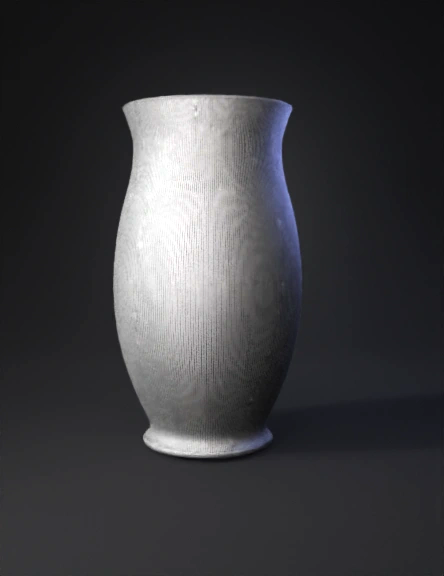
vase 3d model
Tags
3d printing
3d printing realistic
props
props 3d printing
props 3d printing realistic
props realistic
realistic
vase
Prompt
Create a precise 3D model of a rotationally symmetric hollow vase or lamp body using millimeters as units, centered at the origin (0,0,0), with the vertical axis as the Z-axis and the flat base resting on Z = 0, and ensure the base geometry remains fully rotationally symmetric by revolving a 2D profile 360 degrees around the Z-axis. The total height must be exactly 145.0 mm, the maximum outer diameter must be 130.75 mm (maximum radius 65.38 mm), the base outer diameter must be 109.72 mm (base radius 54.86 mm), and the main cylindrical body radius must be 62.50 mm before surface modulation. Define the base outer profile using the following exact control points where Z is height in millimeters and R is outer radius in millimeters: (0, 54.86), (5, 62.50), (10, 64.97), (20, 65.08), (25, 65.38) which is the maximum radius, (30, 65.08), (50, 62.50), (95, 62.50), (140, 62.50), and (145, 54.86). From Z = 0 to Z = 30 create a smooth convex outward bulge with continuous curvature and no sharp edges, reaching the maximum radius at approximately Z = 25 mm; from Z = 50 to Z = 140 create a perfectly vertical cylindrical section with constant radius 62.50 mm; from Z = 140 to Z = 145 create a smooth inward taper from 62.50 mm down to 54.86 mm with continuous curvature and no chamfers. The object must be hollow with a closed bottom at Z = 0 and a uniform wall thickness of approximately 1 mm, with the interior surface following the original smooth base profile as an inward offset; the decorative surface pattern must only modify the exterior surface and must not affect the internal cavity. At the very top, centered on the Z-axis, create a vertical cylindrical bore with diameter 20 mm (radius 10 mm) and depth 5 mm, starting at Z = 145 mm and extending downward to Z = 140 mm. The exterior surface must then be modified with a continuous vertical wave rib pattern covering the entire height from Z = 0 to Z = 145 mm, consisting of evenly spaced, smooth, sinusoidal vertical ribs running parallel to the Z-axis; the ribs must be evenly distributed around the full 360-degree circumference, with approximately 60 identical repeating waves around the perimeter, creating a rhythmic flowing pattern. Each rib must follow a smooth sinusoidal curve in the circumferential direction (theta direction) with a radial amplitude of approximately 3 mm measured from the base radius surface, meaning the outer radius oscillates ±3 mm around the defined base profile while preserving the original underlying shape envelope. The wave pattern must be continuous from bottom to top without interruption, with no hard edges, no sharp creases, and fully smooth transitions between peaks and valleys; the ribs must appear as organic flowing vertical waves, not straight flutes, and should gently oscillate laterally as they rise, producing a soft S-shaped flow when viewed from the side. The base must remain flat and stable despite the rib pattern, with the wave modulation fading smoothly into the bottom plane to maintain printability. All surfaces must remain smooth and manufacturable, the final mesh must be manifold and watertight, and the result must be suitable for 3D printing.
Detailed Info
Related Models
Enter invite code
Enter invite code to get credits!
 maximilianpoeck


 maximilianpoeck