3D Workspace
Home
Assets
Affiliate Program
Sign up/Log in
?
Upgrade
DCC Bridge
Anonymous1762525582
01-22 16:32
Model Name
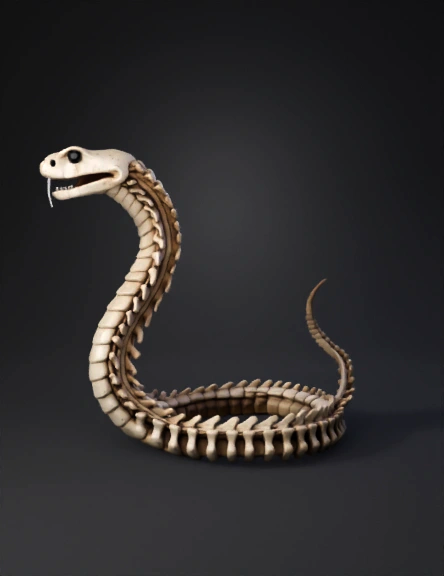
rattlesnake skeleton 3d model
Tags
3d printing
3d printing realistic
creatures animals
creatures animals 3d printing
creatures animals 3d printing realistic
creatures animals realistic
rattle
rattlesnake
realistic
Prompt
Create an extremely high-detail, anatomically accurate rattlesnake skeleton, rendered in true 3D, with every bone precisely defined and biologically correct. The skeleton represents a real rattlesnake species (e.g., Western Diamondback), with correct proportions, vertebral count, and skeletal articulation. The skull is highly detailed, featuring an elongated, lightweight cranial structure with clearly visible sutures, openings, and bone layering. The hinged jaw system is accurately depicted, showing the flexible quadrate bones that allow extreme jaw expansion. The maxillae and palatine bones support long, curved hollow venom fangs, which are semi-translucent, needle-sharp, and anatomically positioned. The vertebral column consists of dozens of individual vertebrae, each uniquely shaped with subtle variation along the body. Cervical vertebrae are slightly thicker near the skull, gradually transitioning into narrower mid-body vertebrae and tapering toward the tail. Every vertebra shows:\n> - Neural spines\n> - Transverse processes\n> - Articulation points\n> - Slight wear and organic asymmetry\n> The rib bones are clearly visible, paired along most of the spine, curving outward in a repeating rhythm. Each rib connects naturally to its vertebra, forming a flexible ribcage that runs nearly the entire body length. The ribs vary subtly in size and angle, emphasizing realism and organic growth patterns. The tail skeleton transitions seamlessly into the rattle, composed of a series of hollow, interlocking keratin segments. Each rattle segment shows natural imperfections: chipped edges, uneven thickness, micro-cracks, and age-related discoloration. The connection between the final caudal vertebra and the first rattle segment is anatomically plausible and mechanically believable. Bone material appears aged and natural, with a matte calcium texture, faint porosity, hairline cracks, and subtle color variation ranging from pale ivory to warm yellowed bone. Crevices show darker shading from accumulated dust and age. No stylization or exaggeration—everything appears grounded in real-world osteology. The skeleton is posed in a dynamic yet realistic rattlesnake stance: partially coiled, spine forming elegant S-curves, skull elevated slightly above the body, tail lifted with the rattle angled back. The pose communicates tension, readiness, and latent danger while maintaining anatomical plausibilit
Detailed Info
Related Models
Enter invite code
Enter invite code to get credits!
 Anonymous1762525582


 Anonymous1762525582