3D Workspace
Home
Assets
Affiliate Program
Creator Program
Sign up/Log in
View Plans
DCC Bridge
rednas2000
12-14 21:37
Model Name
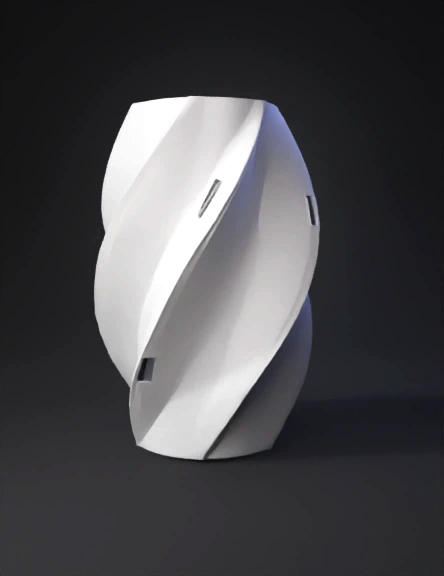
twisted vase 3d model
Tags
props
props realistic
props rendering
props rendering realistic
realistic
rendering
rendering realistic
twisted vase
Prompt
Create an original sculptural table lamp shade optimized for 3D printing in white PLA with a soft translucent glow. The design must feel technical and elegant, extremely asymmetrical, with a strong twisted motion and a “wow” optical illusion depth effect that changes when viewed from different angles. The shape must be freeform and clearly not a standard drum, cone, dome, or vase style shade, and it must not resemble existing commercial lamp shades. Geometry and dimensions (must follow exactly) Real world scale. Use millimeters. Overall height: max 390 mm from top to bottom. Target 360 to 390 mm. Maximum size from center: max radius 130 mm in any direction. Total maximum diameter 260 mm. The shade is a single closed shell with a closed bottom. No open bottom. The top is closed, except for one centered mounting hole. Mounting hole: 11.0 mm diameter, perfectly centered, straight through. Reinforced collar at the top around the hole: keep the hole diameter 11.0 mm, add a thicker “lip” region with 4.0 mm thickness. Provide a clean flat seating area for a washer. Suggested collar outer diameter 24 to 30 mm. White PLA translucency and hotspot control (important) The shade should glow softly through the material. Use uniform wall thickness 1.6 to 2.2 mm, target 1.8 to 2.0 mm for translucency. Prevent harsh bulb hotspots and glare. Do this by shaping the geometry so there is no direct line of sight to the bulb from most side angles. Use overlapping layered forms, offset shells, and internal occlusion created by the outer geometry, without adding separate intersecting parts. Keep the outside smooth and clean. External surfaces must remain crisp and elegant, not noisy. Optical illusion and wow effect (core style) Create a strong depth illusion using geometry and negative space, suitable for a glowing translucent material: Large smooth planar facets with sharp edges and controlled twists. Layered angular ribbons and folded surfaces that visually overlap and create parallax. Strategic slit windows and voids that create shifting shadow lines and depth cues, but keep them fewer and more intentional than a fully perforated shade, because white PLA already transmits light. The illusion must come from form, overlaps, and carefully placed openings, not from surface texture. Lighting intent The bulb sits high in the internal frame. The shade should emit light in all directions, primarily sideways. Because the material is translucent, allow the body to glow. Add only selective openings to produce crisp shadow play and reveal depth. Closed bottom, but the inner volume and silhouette should guide light so it feels sculptural and premium. Printability constraints (PLA, one piece) Make it a single watertight manifold mesh with clean normals. Avoid ultra thin spikes and fragile tips. Minimum slit or opening width: 1.2 to 2.0 mm, target 1.5 mm. Prefer overhangs that can print with minimal supports. Keep dominant surfaces within about 55 degrees from vertical where possible. No intersecting shells. No self intersections. No non manifold edges. Finish and surface Material look: milky translucent white PLA, matte. Surfaces must be smooth. No ribbed fluting. No wavy micro texture. “Angular but smooth”. Crisp edges, planar transitions, subtle chamfers where needed for strength. Internal clearance Maintain a clear central interior volume for an E14 bulb and socket area. Keep at least a clearance cylinder around the centerline, suggested 45 to 55 mm diameter and 90 to 120 mm height, without internal obstructions near the top mounting area. Deliver one final lamp shade model only, centered at origin, upright orientation, with the mounting hole at the top center.
Detailed Info
Related Models
Enter invite code
Enter invite code to get credits!
 rednas2000


 rednas2000