3D Workspace
Home
Assets
Affiliate Program
Sign up/Log in
?
Upgrade
DCC Bridge
Anonymous1769021233
01-29 17:56
Model Name
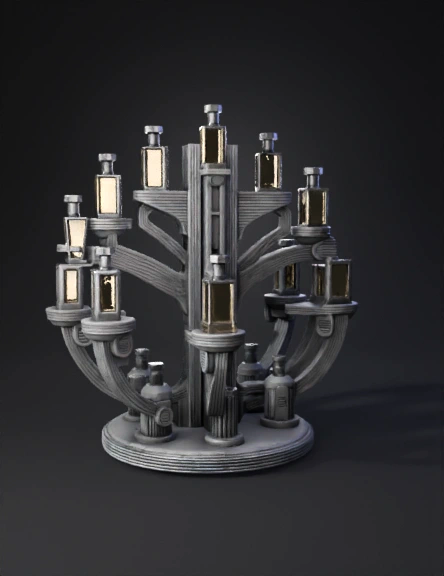
luxury perfume display 3d model
Tags
3d printing
3d printing realistic
design
perfume display stand
props
props 3d printing
props 3d printing realistic
props realistic
realistic
Prompt
Create an ultra-premium, highly complex 3D printable fragrance display inspired by precision engineering, mechanical watch movements, and futuristic luxury product design. Overall concept: – Design language based on precision mechanics, controlled geometry, and engineered elegance – The structure should feel machined, intentional, and technical rather than organic – Inspired by luxury watches, high-end audio equipment, and sci-fi interior design – The object should appear complex, layered, and engineered from multiple interacting parts Capacity: – Holds exactly 12 to 15 standard perfume bottles (50–100 ml) – Bottle slot diameter: 33–36 mm – Bottle slot depth: 26–30 mm Spatial layout: – Bottles arranged in concentric arcs or radial geometry – Clear central axis or spine that defines the design – Bottles positioned in offset vertical levels – Each bottle seated in a precision cradle that appears machined into the structure – Visual balance between symmetry and controlled variation Structural system: – Central backbone or frame acting as the main load-bearing element – Secondary arms or brackets extend from the backbone to hold bottles – Structural elements overlap and interlock visually – Load paths are visible through thickened struts and reinforced joints – Base integrated into the frame with stepped mass for stability Geometric complexity: – Combination of straight lines, arcs, and circular features – Layered plates, ribs, and cutouts stacked with intentional spacing – Parametric perforations and mechanical vent patterns – Thickness variation to indicate structural hierarchy – No decorative geometry that does not serve a visual or structural purpose Surface detailing: – Micro-bevels and chamfers on all edges – Subtle engraved-style grooves and mechanical linework – Matte primary surfaces with slightly recessed secondary details – Design should look premium even without post-processing 3D printing engineering constraints: – Explicitly designed for FDM printing – Maximum overhang: 45° – Minimum wall thickness: 4 mm – Load-bearing ribs minimum: 6 mm – Bottle cradle lips minimum: 5 mm – All geometry must be self-supporting – No thin floating features – No enclosed voids that trap supports Modularity and assembly: – Split into 3 to 5 mechanically interlocking modules – Slide-in rails, dovetail joints, or keyed mechanical interfaces – Assembly should feel precise and engineered – No screws, glue, or external fasteners – Seams should align with geometric breaks to visually disappear Print optimization: – Each module fits within desktop FDM printer build volume – Flat reference planes for bed adhesion – Optimized for printing without supports – Balanced mass to minimize warping Material and finish assumptions: – PLA or PETG – Designed for matte, satin, or metallic-look filament – Layer lines acceptable and integrated into the aesthetic Output requirements: – Clean, watertight, manifold mesh – STL export-ready – Optimized for 0.2 mm layer height – No logos, no text, no branding
Detailed Info
Related Models
Enter invite code
Enter invite code to get credits!
 Anonymous1769021233


 Anonymous1769021233