3D Workspace
Home
Assets
Affiliate Program
Creator Program
Sign up/Log in
View Plans
DCC Bridge
gowivi8301
12-15 16:58
Model Name
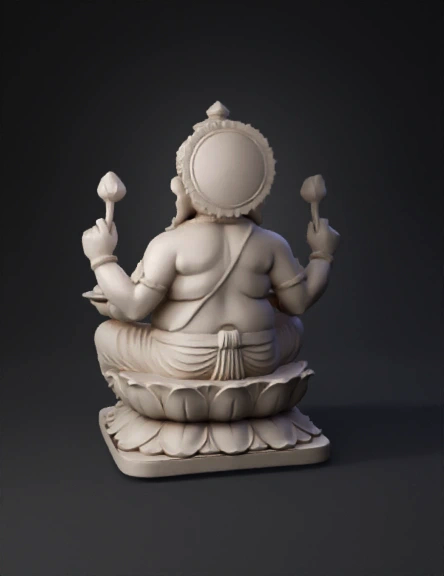
ganesha statue 3d model
Tags
clay
elephant headed deity
ganesha statue
props
props clay
props rendering
props rendering clay
rendering
rendering clay
Prompt
Create ONE complete, unified 3D sculpture of Lord Ganesha in a traditional Indian temple style, strictly following classical proportions and devotional sculpture standards. 1. Overall Form & Proportions The sculpture must depict a soft, rounded, full-bodied form — not slim or muscular. The torso is broad and heavy, with gentle chest volume and a naturally prominent rounded belly. The back must retain the same volume as the front, including realistic curvature and soft fat folds, with no flattening, hollowing, or simplification from any angle. Lord Ganesha is seated in an asymmetrical, grounded posture on a layered lotus pedestal. 2. Exact Leg Position (Must Match Precisely) RIGHT LEG — Folded Across the Lap The right leg folds inward across the body, forming a compact cross-lap pose. The thigh runs diagonally from the right hip toward the center of the body. The knee remains lower than the belly, never lifted high. Upper thigh slopes downward and inward at approximately 25–30°. Thigh volume is soft and rounded, with no sharp bends or exaggerated flex. Right Foot Placement The right foot rests gently on the left thigh near the toes, not on the knee. Foot angles slightly downward. Heel is partially visible. Sole faces slightly forward and inward. All five toes are clearly visible, relaxed, and slightly splayed. The big toe is dominant; remaining toes reduce naturally in size. The foot shows visible contact pressure, gently sinking into the left thigh — never floating. LEFT LEG — Open Outward and Grounded The left leg opens outward naturally, creating stable asymmetry. The knee points leftward and slightly forward. Upper thigh slopes downward and outward at approximately 35–40°. Thigh mass is broader and more grounded than the right thigh. Left Foot Placement The left foot rests flat on the lotus pedestal. Fully weight-bearing with the heel clearly seated. Sole angles slightly toward the viewer. Inner arch is visible; foot is not unnaturally flattened. All five toes are visible, gently curled and resting naturally on the pedestal edge. Toes align forward, not twisted sideways; the big toe is slightly separated. 3. Arms & Hands (Four Arms Total) Lord Ganesha has four arms arranged symmetrically: Upper arms rise slightly outward and upward. Lower arms project forward and downward. Arm thickness is rounded and heavy, consistent with the soft body mass. No arm overlaps unnaturally; all joints are clearly readable. All hands are positioned so that each gesture is visually clear from the front. 1️⃣ LOWER RIGHT HAND — ABHAYA MUDRA (BLESSING HAND) Position Located at the front-right side of the body, slightly below chest level. Forearm extends forward from the elbow, not lifted high. Hand sits in front of the torso, not touching the body. Angle Palm faces directly forward, almost perpendicular to the viewer. Wrist is straight with a very slight inward relaxation. Fingers angle slightly upward, not vertical. Finger Setup All five fingers clearly visible. Fingers are naturally separated, not stiff. Middle finger is longest and most central. Index and ring fingers curve gently inward. Little finger curves slightly more. Thumb is clearly visible, angled inward and downward. Gesture Logic This is a true abhaya mudra: Calm, reassuring No tension or force Hand size is proportional — not oversized. 2️⃣ LOWER LEFT HAND — MODAK PLATE HOLDER Position Positioned in front of the left side of the belly, slightly lower than the right hand. Elbow is bent comfortably; forearm moves forward and inward. Angle Palm faces upward at a shallow angle, not flat. Wrist is slightly bent backward to support the plate. Plate sits horizontally but follows palm curvature. Finger Setup All five fingers present and functional. Fingers curve upward to cradle the plate. Thumb supports the plate edge from the side. Fingers are not clenched — gentle support only. Interaction with Object Plate rests fully on the palm, not floating. Lower left hand holds a shallow plate containing five small modak sweets, tightly arranged. Modaks sit tightly together, forming a mound. Hand shows load-bearing logic (subtle tension). 3️⃣ UPPER RIGHT HAND — LOTUS HOLDER Position Raised above shoulder level on the right side. Elbow bent outward; arm does not hug the body. Hand is positioned clearly away from the head and ear. Angle Forearm angles upward at approximately 45°. Wrist remains neutral — not bent excessively. Lotus is held upright, vertical to gravity. Finger Setup All five fingers present. Thumb and index finger primarily grip the lotus stem. Remaining fingers support from behind. Fingers are slender but rounded — stone-carved softness. Visual Clarity Lotus does not overlap the crown or ear. Gesture is readable and elegant. 4️⃣ UPPER LEFT HAND — LOTUS HOLDER Position Mirrors the upper right hand symmetrically. Raised above shoulder height on the left side. Elbow bent outward. Angle Forearm rises upward at the same approximate 45°. Wrist neutral. Lotus held upright. Finger Setup All five fingers clearly defined. Grip mirrors the opposite hand: Thumb + index for control Other fingers for support No finger fusion or stiffness. Symmetry Note Upper left and right hands are: Equal in height Equal in distance from the body Matching in gesture and proportion 5️⃣ RELATIONSHIP BETWEEN ALL FOUR HANDS (CRITICAL) Hands form a balanced vertical hierarchy: Upper hands = offering / symbolism Lower hands = blessing + sustenance No hand blocks another. No gesture competes visually. All hands remain within the natural reach of their arms. Fingers are relaxed, devotional, and human-like, not mechanical. Hand Anatomy Enforcement Each hand must have exactly five fingers. Fingers are clearly separated, anatomically believable, and well defined. No missing, merged, simplified, or extra fingers. Arms are thick, rounded, and heavy, consistent with overall body mass. Back anatomy (shoulder blades, arm thickness, ornament straps) aligns perfectly with the front. 4. Trunk The trunk extends downward from the face and curves gently to the LEFT side of the body. The curve is smooth and natural, with evenly spaced trunk rings. The tip delicately holds a single modak, touching it gently — not gripping tightly. Trunk direction, length, and curvature remain consistent across front, side, and back silhouettes. 5. Head & Crown Elephant head with calm, almond-shaped eyes. Large ears flare outward, thick at the base and thinner toward the edges. A tall, ornate carved crown (mukuta) with layered tiers and central leaf/teardrop motifs. The crown includes a fully sculpted rear halo disc — no flat or unfinished back surfaces. 6. Modak Description Modaks (Ukadiche Modak) are plump, conical or teardrop-shaped sweets with delicate pleats, resembling a flower bud or small pouch. 7. Ornaments & Attire (Unified Material) Include carved: Necklaces (layered) Armlets Wrist bracelets Anklets Waist ornament All ornaments are sculpted from the same ivory-marble material, with crisp, deep detailing. No metallic shine, no color variation. 8. Drapery — Front Structure A thick waist belt anchors the dhoti below the belly. Heavy cloth emerges beneath the belt with deep, rounded folds. A central front hanging fold descends between the legs, narrow at the top and widening slightly downward. Drapery spreads asymmetrically over the thighs: Compressed folds on the folded right leg Broader, open folds on the outward left leg Drapery responds naturally to gravity and leg position. 9. Drapery — Back Structure A horizontal waist band wraps fully around the body. From the center of the back waist band, a vertical cloth tail descends: Narrow at the top, widening downward Ends just above the lotus pedestal Deep, rounded, symmetrical folds Drapery spreads over both hips and wraps under the body toward the front. Cloth rests on the pedestal with slight compression — never floating. 10. Back Anatomy & Ornaments Back is broad, soft, and heavy, matching the front mass. Gentle fat folds above the waist; subtle spine suggestion without sharp ridges. A diagonal sacred strap runs from the left shoulder across the back to the right waist. Circular armlets sit at mid-upper arms, thick and rounded, naturally embedded in the flesh. All backside elements are fully sculpted and symmetrical. 11. Pedestal A layered lotus pedestal with thick, rounded petals. Upper and lower layers clearly separated. Drapery and feet rest naturally on the top lotus layer. 12. Material & Finish Uniform ivory-marble stone appearance Matte finish with subtle stone grain Soft, diffused lighting High-resolution sculptural detail visible from all angles 13. Output Requirements (Strict) One finished statue only Fully detailed 360° Perfect consistency between front and back No stylization, no modern interpretation Suitable for professional 3D sculpting, rendering, CNC, or physical production
Detailed Info
Related Models
Enter invite code
Enter invite code to get credits!
 gowivi8301


 gowivi8301