3D Workspace
Home
Assets
Affiliate Program
Sign up/Log in
?
Upgrade
DCC Bridge
Anonymous1768496219
01-15 17:01
Model Name
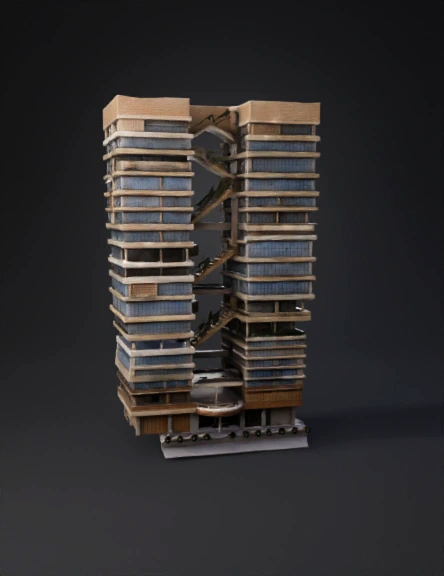
twisted tower 3d model
Tags
architecture
architecture realistic
architecture rendering
architecture rendering realistic
design
realistic
rendering
rendering realistic
twisted tower
Prompt
Design a 16-storey institutional building with one basement, ground floor, podium, and stacked upper floors for Mizoram Bhavan, conceived as a vertical cultural institution that embodies movement, transition, and evolving identity rather than a static form. The architecture must be generated on a compact urban plot of approximately 2,195 sq.m, constrained by 9 m setbacks on two road-facing sides and 6 m setbacks on the remaining edges, resulting in a reduced and strategically carved floor plate. The form should respond intelligently to these constraints by compressing, rotating, and layering space vertically. Each successive upper floor plate is rotated by 15 degrees, creating a progressive torsional geometry, inspired by Revolution Tower and Evolution Tower, but interpreted uniquely through the lens of Mizoram’s topography, tribal continuity, and cultural dynamism. The rotation should not appear cosmetic; it must express temporal growth the roation of floors are at 15degree each, adaptive governance, and shifting perspectives—a metaphor for Mizoram’s evolving socio-cultural identity within the national framework. The basement functions as secure services, parking, and building infrastructure. The ground floor acts as a porous civic threshold, visually open, culturally inviting, and publicly accessible. The podium serves as a collective institutional anchor, housing shared functions, ceremonial spaces, and administrative interfaces. The upper floors accommodate institutional, residential, or administrative programs arranged around a central spatial void. Introduce a central spiral staircase that cuts vertically through the rotating mass, not as a conventional circular stair but as a twisting, angular, sculptural connector—symbolizing cultural continuity, oral traditions, and upward movement rooted in Mizo society. This stair should visually link multiple floors (especially 2nd and 3rd levels), functioning as both circulation and spatial experience. Complement this with a secondary dog-legged staircase positioned along the offset edge, designed primarily for fire safety and service circulation, while maintaining visual discipline with the overall form. Place toilets and service cores along the opposite edge, strategically using them as structural stabilizers for the rotating plates and as buffers against heat, noise, and urban adjacency. The building’s structural logic must be clearly legible: a central core system resisting torsion, combined with peripheral columns or shear elements adapting to rotational geometry. The structural expression should reinforce the idea of controlled movement and balance, not chaos. The façade should read as a layered, shifting skin, reacting to the rotation of floors—creating overhangs, shadow play, and depth. Materials may reference timber textures, woven patterns, and stratified surfaces, abstracted from Mizo craft, bamboo construction, and hilly terrain, without literal replication. Overall, the building must feel like a living institution in motion—a vertical narrative of culture, governance, and transformation, where every rotation, stair, and setback is purposeful, responding simultaneously to urban constraints, climatic logic, structural clarity, and cultural meaning.
Detailed Info
Related Models
Enter invite code
Enter invite code to get credits!
 Anonymous1768496219


 Anonymous1768496219