3D Workspace
Home
Assets
Affiliate Program
Creator Program
Sign up/Log in
View Plans
DCC Bridge
jerichoalt7
12-11 04:03
Model Name
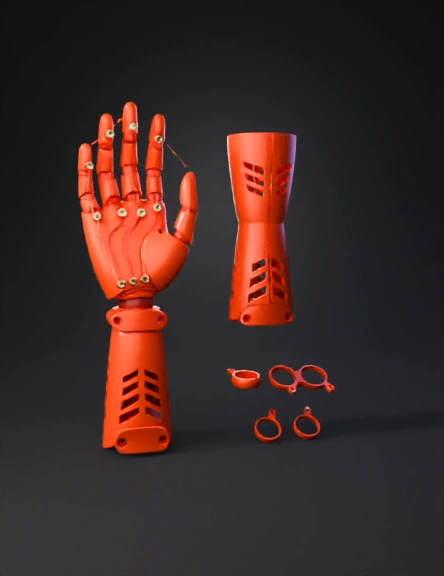
prosthetic hand 3d model
Tags
3d printing
3d printing realistic
machine
machine 3d printing
machine 3d printing realistic
machine realistic
prosthetic hand
realistic
Prompt
Generate 3D-printable STL files for a simple tendon-driven prosthetic right hand with an extended forearm section for classroom demonstration. The device should include: a palm base, 5 tendon-driven fingers, an extended forearm tube, a wrist connector area, pulley channels, and a strap system. • Palm base: rectangular/rounded plate sized for an adult hand (110 mm wide × 90 mm long × 12 mm thick). • Add shallow channels on top of the palm for 5 cable paths (4 fingers + thumb), each channel leading to a rounded cable guide or small pulley (8–12 mm diameter). • Add mounting holes on the rear edge of the palm for attaching the forearm tube. • Create 5 fingers with three straight segments (proximal, middle, distal). Use adult-scale total finger lengths: - Thumb: 55 mm - Index: 75 mm - Middle: 80 mm - Ring: 75 mm - Little: 65 mm • Split each into 40% proximal, 30% middle, 30% distal (round to nearest mm). • Add aligned joint holes sized 3.4 mm diameter for standard 3 mm pins or bolts. • At the fingertip, include a 2.0 mm hole for cable anchoring and a small clamp plate area to secure the tendon. • Add a clear path for each tendon from the palm guide to the fingertip. • On the backside of each proximal finger segment, include two 4 mm holes for attaching a small return spring or rubber band back to the palm. • Create a hollow forearm tube approx. 160–200 mm long (adult forearm length) that attaches directly to the back of the palm. • Tube inner diameter approx. 45–55 mm (large enough to slide an arm inside or to look like a realistic prosthetic housing). • Tube thickness approx. 3–4 mm for strength. • Add vent holes or simple geometric cutouts to reduce print time. • Include 4 slotted strap holes near the wrist end and 4 more near the elbow end for Velcro straps. • The forearm tube should taper slightly toward the wrist and remain straight toward the elbow end for an aesthetic, realistic look. • Add a flat, reinforced interface where the palm and forearm tube connect—either with snap-fit tabs or screw holes. • Include 4 screw holes (optional) for secure attachment. • Include printable control rings sized for average adult fingers. Each ring should have a small loop or slot for tying the tendon cord. • Finger segment walls: 3 mm thick • Palm thickness: 12 mm • Forearm tube: 3–4 mm walls • Reinforce all high-stress areas (joint regions and palm base) • Create separate STLs for every part: palm_base.stl, forearm_extension.stl, finger segments for each finger, pulley wheels, and control rings. • Palm: flat on the printer bed • Finger segments: lay flat on their broad side • Forearm tube: print upright or in two halves • Pulleys upright Make the design sturdy, clean, and simple enough to assemble using basic metal pins, fishing line, and small extension springs. Output all files as separate STL models clearly labeled. • Each finger must have a built-in internal tunnel running from the palm connection point through the proximal and middle segments to the fingertip clamp. • The tunnel should be approximately 2.0–2.5 mm in diameter to allow fishing line to move smoothly. • At the palm, create a CLEAR entry port for each tendon: a rounded opening or socket where the string enters the finger tunnel. • Include a small rounded guide or pulley at the tendon entry so the string bends smoothly without friction. • At the fingertip, include a 2.0 mm exit hole and a small clamp plate area to tie or pinch the fishing line securely. • Ensure all tendon paths are straight or gently curved for low resistance.
Detailed Info
Related Models
Enter invite code
Enter invite code to get credits!
 jerichoalt7


 jerichoalt7