3D Workspace
Home
Assets
Affiliate Program
Sign up/Log in
?
Upgrade
DCC Bridge
Anonymous1747472495
12-03 00:38
Model Name
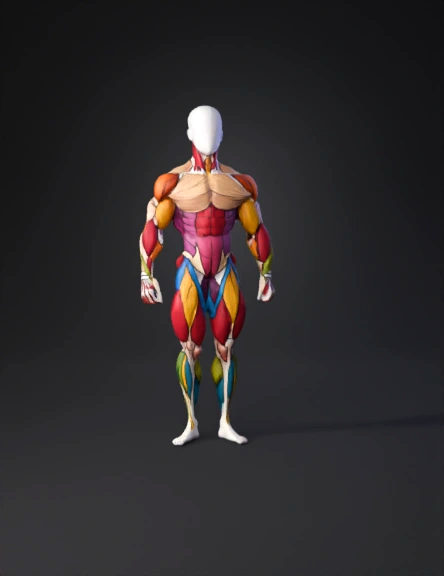
muscular anatomy 3d model
Tags
character
character game asset
character game asset stylized
character stylized
game asset
game asset stylized
human muscular anatomy
muscle
stylized
Input
Prompt
Generate a highly detailed, anatomically precise 3D human male model showcasing the complete muscular system from both anterior (front) and posterior (back) views. The model must be rendered with medical-grade accuracy, suitable for professional educational or clinical use. Model Specifications: Pose: Standing upright in anatomical position — arms slightly away from torso, palms facing forward, feet parallel. Muscle Detail: Every major and minor skeletal muscle must be clearly visible, separated, and individually defined with accurate fiber direction, origin/insertion points, and realistic texture. Include deep muscles (e.g., rotator cuff, iliopsoas, intercostals, deep back muscles) alongside superficial ones. Color Coding: Use distinct, scientifically appropriate colors per muscle group (e.g., reds for flexors, blues for extensors, yellows for abductors) to enhance visual differentiation — but ensure naturalistic shading and lighting for realism. Labels & Annotations: Add clean, legible, non-intrusive labels connected by thin lines to each major muscle. Use standard anatomical terminology (Latin names preferred, e.g., Biceps Brachii, Gluteus Maximus, Tibialis Anterior). Group labels logically by body region (Neck, Shoulders, Chest, Back, Arms, Abdomen, Thighs, Calves). Viewports: Render two separate high-resolution views: Front View — showing anterior musculature including pectorals, deltoids, biceps, rectus abdominis, quadriceps, tibialis anterior. Back View — showing posterior musculature including trapezius, latissimus dorsi, erector spinae, glutes, hamstrings, gastrocnemius. Background & Lighting: Neutral light gray background with soft studio lighting to highlight muscle contours without harsh shadows. No distracting elements. Resolution & Format: Ultra-high resolution (4K+), suitable for print or digital display. Output as a 3D model (OBJ/GLB) if possible, with optional 2D renderings for each view. Style: Realistic, photorealistic rendering — not cartoonish or stylized. Think “medical textbook illustration meets 3D scan.” Avoid skin, bones, or organs unless requested — focus purely on musculature. Additional Notes: Ensure no overlapping labels, maintain proportional scale, and include tendons where they attach visibly to bone (e.g., Achilles tendon, patellar tendon). If possible, provide layered files or exploded views for advanced study.
Detailed Info
Related Models
Enter invite code
Enter invite code to get credits!
 Anonymous1747472495


 Anonymous1747472495