3D Workspace
Home
Assets
Affiliate Program
Creator Program
Sign up/Log in
View Plans
DCC Bridge
zersarp
11-23 19:59
Model Name
polygonal texture 3d model
Tags
abstract symbol
abstract symbol game asset
abstract symbol game asset stylized
abstract symbol stylized
abstract texture
game asset
game asset stylized
microcar
stylized
Prompt
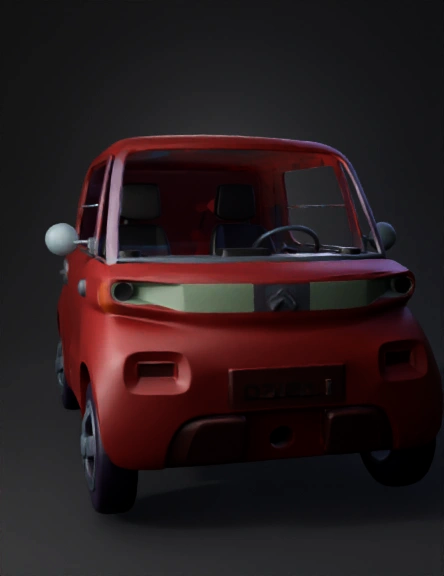
Generate a single watertight, 3D-printable STL of a compact electric microcar inspired by the Citroën Ami (modern, post-2018 design). Requirements: General - Style: modern, compact, understated (not flashy), looks like a manufactured human design (no organic or humanoid features). - Scale: provide a model scaled to 1:20 by default (the generator may also export real-world mm dimensions). Output file: STL. - Make the geometry clean, manifold, and repair-free (watertight). No non-manifold edges, no internal loose geometry. Exterior - Shape: boxy but slightly rounded edges (microcar silhouette). Overall compact proportions. - Roof: continuous roof/top panel included. - Side mirrors: present (simple, not overly thin). - Headlights: simple, recessed or flush-mounted pair at front. - Taillights / brake light: include rear brake light cluster; clearly modelled as raised or recessed geometry. - No exhaust or exhaust outlet anywhere. - Place a small "Force-A" embossed logo centered on the hood (shallow emboss, max height 0.8–1.2 mm so it prints cleanly). Wheels & Undercarriage - Wheels: moderately realistic but simplified (not hyper-realistic). Tires simple rounded profile, rim detail minimal—designed to print without fine spokes. Wheels should be separate parts or clearly defined so they can be removed/printed separately if needed. - Wheel wells / arches included and have at least 2 mm clearance from tire outer surface. - Orientation: model oriented for printing with wheels down (flat stable base) unless exporting in parts. Interior & Functional - Seats: exactly two seats, simplified geometry (no tiny stitches). Seats must be structurally integrated or easily solidified for printing. - Steering wheel: present but low-detail (simple ring and column). - Dashboard & controls: minimal, not highly detailed — enough to read as a dash. - Interior must be optimized to minimize material: hollow shell with uniform wall thickness (default shell 2.5 mm) and at least two drainage/escape holes (4–6 mm) if hollowing is used. Alternatively produce solid parts if the tool cannot hollow reliably. - All thin features (mirrors, antenna) should be at least 1.2–1.5 mm thick to print reliably. Printability constraints - Minimum printable feature size: 0.8–1.0 mm for embossed details; 1.2 mm minimum wall thickness for fragile parts. - Ensure the model is printable on a standard FDM printer without excessive supports: avoid extreme overhangs >60°. If unavoidable, mark/support interfaces clearly. - Export a single STL (or a zipped set of STLs) with separated parts if needed: body, 4 wheels, roof (optional), mirrors — label parts clearly in metadata if possible. Aesthetics & Avoidances - Do not produce photorealistic textures, faces, or humanoid features. - Avoid extremely high polygon noise or micro-details that will look bad when scaled or smoothed by humans. - Keep overall polygon count moderate so Tinkercad/Blender can open the file (not millions of triangles). Deliverables - Output: STL file(s) suitable for direct 3D printing and import to Tinkercad. - Provide a note: “Model scaled 1:20; wall thickness 2.5 mm; hollow with two drainage holes 5 mm diameter” in the model metadata or as a short text file. End.
Detailed Info
Related Models
Enter invite code
Enter invite code to get credits!