3D Workspace
Home
Assets
Affiliate Program
Sign up/Log in
?
Upgrade
DCC Bridge
Anonymous1766638811
12-26 07:02
Model Name
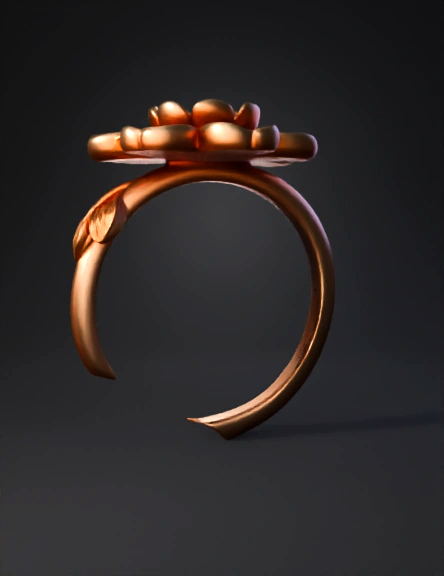
gold flower ring 3d model
Tags
gold flower ring
props
props realistic
props rendering
props rendering realistic
realistic
rendering
rendering realistic
Input
Prompt
Here is a detailed description of the ring designed to guide a 3D modeler. I have broken it down by component, geometry, and texture/finish. 1. General Overview * Type: Statement floral cocktail ring. * Style: Realistic botanical, luxury jewelry. * Material: Yellow Gold (approx. 18k or 22k appearance). 2. The Centerpiece (Flower) The flower is the focal point and consists of three distinct parts: the center cluster, the inner petals, and the outer petals. A. The Center (Stamen/Pistil) * Geometry: A tight cluster of approximately 7-9 small, highly polished spheres (beads). * Arrangement: One central sphere surrounded by a ring of slightly smaller spheres. They sit deep within the cup of the inner petals. * Finish: High-gloss polish (mirror finish). B. Inner Petal Layer * Count: 5 petals. * Shape: Cupped upwards, embracing the center cluster. The shape is roughly oval with a slight dip in the middle of the outer edge (heart-like). * Surface Detail (Crucial): * Interior Face: Heavily textured with fine, radial striations (grooves) running from the base toward the tip. This mimics natural flower veins. In 3D, this would require a normal/bump map or displacement map. * Edges: The borders of the petals are raised, thick, and smooth. This creates a "lipped" border that separates the textured interior from the outside world. * Finish: The textured interior has a satin/matte look due to the grooves; the raised edges are high-gloss polished. C. Outer Petal Layer * Count: 5-6 petals (partially obscured by the top layer). * Position: These sit lower and wider than the inner layer, creating a "blooming" effect. They are offset from the inner petals (the tip of an outer petal sits between two inner petals). * Shape: Flatter and broader than the inner layer. * Surface Detail: Same as the inner layer—striated interior surface with a thick, polished, rolled edge. 3. The Leaves * Location: Visible on the left side of the band, branching out from where the shank meets the flower head. * Count: 2 small leaves. * Geometry: Leaf-shaped, curving gently downward along the finger. * Texture: Similar to the petals—fine engraved lines acting as veins, with a smooth, polished perimeter outline. 4. The Band (Shank) * Profile: Simple, round wire profile (circular cross-section). * Thickness: Uniform thickness, appearing sturdy but delicate compared to the large flower head. * Connection: The band flows seamlessly into the base of the flower (the gallery), likely merging into the underside of the outer petals. * Finish: High-gloss polish. Completely smooth, no texture. 5. Technical Notes for Modeling * Topology: High-poly counts will be needed for the petal interiors to capture the striations if sculpting geometry. Alternatively, use a high-quality displacement map for the grooves to keep the poly count lower. * Hard vs. Soft Edges: The transition from the textured interior of the petal to the smooth rim should be soft but distinct. The rim itself needs a bevel to catch the light (specular highlight). * Ambient Occlusion: Ensure the crevices between the petal layers and the spheres in the center are deep enough to create natural shadowing, giving the piece depth.
Detailed Info
Related Models
Enter invite code
Enter invite code to get credits!
 Anonymous1766638811


 Anonymous1766638811