3D Workspace
Home
Assets
Affiliate Program
Sign up/Log in
?
Upgrade
DCC Bridge
Anonymous1772031936
02-25 15:38
Model Name
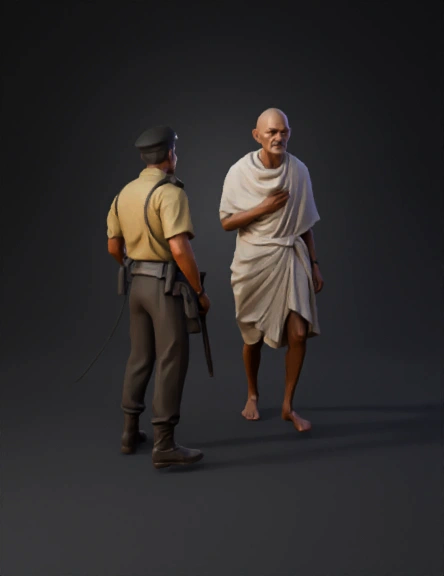
historical crowd 3d model
Tags
character
character historical
character rendering
character rendering historical
historical
man in white robe
rendering
rendering historical
Prompt
I remember the cold morning air of 4 February 1922 in the small town of Chauri Chaura in Uttar Pradesh. I stand before you not as a hero, not as a judge — but as a witness to a turning point in India’s freedom struggle. At that time, the country was restless. The Indian National Congress had launched the Non-Cooperation Movement under the leadership of Mahatma Gandhi. We were told to boycott British goods, refuse cooperation, and protest peacefully against the rule of the British Raj. The word that guided us was simple but powerful: nonviolence. That day, a group of protestors marched through Chauri Chaura. I can still hear the slogans for freedom echoing through the bazaar. But tensions were high. When police confronted the protestors and tried to disperse them, anger replaced discipline. The crowd, once marching with purpose, began to lose control. What followed changed everything. In a surge of fury, the protest turned violent. A police station was set on fire. Policemen trapped inside lost their lives. It was no longer a protest. It was no longer non-cooperation. It was chaos. And I remember the silence that followed. News of the incident spread quickly across India. When Mahatma Gandhi heard what had happened, he was deeply shaken. For him, freedom built on violence was not true freedom. He believed the nation was not yet ready to handle the responsibility of nonviolent resistance. Within days, he made a shocking decision — he called off the entire Non-Cooperation Movement. Many were confused. Some were angry. “Why stop now?” they asked. But Gandhi believed that means were as important as the goal. If India wanted independence, it had to prove moral strength, not just physical force. As I narrate this, I see Chauri Chaura not just as a place — but as a lesson. It reminds us how quickly anger can derail a movement. It shows how leadership sometimes requires stepping back, even when momentum is strong. The Chauri Chaura incident was not the end of India’s struggle for freedom. But it was a pause — a moment of reflection. A reminder that discipline, unity, and principle matter just as much as passion. History does not just record victories. It records decisions. And that day, India learned the cost of losing control — and the weight of choosing conscience over revenge.
Detailed Info
Related Models
Enter invite code
Enter invite code to get credits!
 Anonymous1772031936


 Anonymous1772031936