3D Workspace
Home
Assets
Affiliate Program
Creator Program
Sign up/Log in
View Plans
DCC Bridge
tekanguyen
10-15 03:06
Model Name
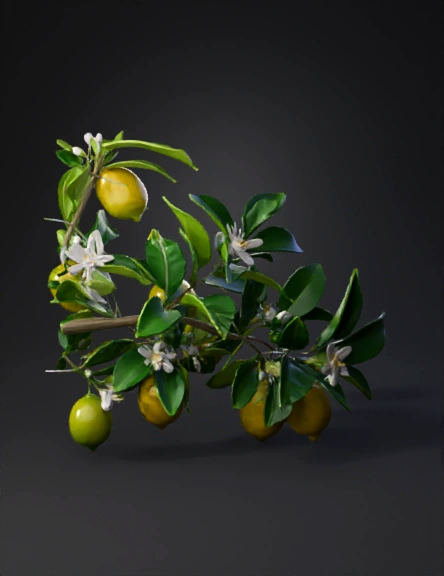
lemon tree 3d model
Tags
bulbous growths
fruit clusters
lemon tree
melena
nature environment
nature environment realistic
nature environment rendering
nature environment rendering realistic
realistic
rendering
rendering realistic
un arbre
Prompt
Ok, here's the updated and refined prompt in English, emphasizing leaf orientation, smooth fruit polys, and further details. 3D Modeling Prompt: Highly Detailed & Realistic Lemon/Lime Tree and Fruit (Refined) Primary Subject: A highly detailed, realistic 3D model of a citrus tree (specify if *Lemon - Citrus × limon or Lime - Citrus aurantifolia is preferred) with fruit, flowers, and leaves. The model should be optimized for close-up views and high-resolution rendering, with particular attention to natural leaf orientation and smooth fruit geometry. I. Tree Structure (Trunk and Branches) Type: Small woody tree or shrub, mature specimen. Height: Model should represent a natural size, approximately 3-5 meters tall. Trunk & Bark: Medium brown to greyish-brown, with a realistic, slightly fissured or textured bark. No unnatural smoothness. The main trunk should transition smoothly into multiple, naturally spreading branches. Branches: Complex branching structure, forming a dense, slightly irregular canopy. Branches should show subtle variations in thickness and organic growth patterns. Thorns: Essential detail. Integrate numerous sharp, pointed thorns (spines) along the younger and older branches, varying in length (3-7 mm) and orientation, appearing naturally integrated into the bark. II. Foliage (Leaves) Shape: Simple, alternate leaves. Predominantly ovate to elliptical, with a distinct, slender pointed tip (acuminate) and a rounded or cuneate base. Size: Varied realistic sizes, generally 5-11 cm long and 3.5-6 cm wide. Texture & Color: Upper surface: Smooth, highly glossy, dark emerald green. Lower surface: Slightly lighter, duller green, with faintly visible vein structure. No artificial reflectivity. Edges: Clearly defined, finely serrated to crenulate (scalloped) margins. Petiole (Leaf Stem): Include a short, sturdy petiole. For lime varieties, model a subtle, narrow wing on the petiole; for lemons, a plain petiole is typical. Orientation (CRITICAL): Leaves must hang and orient themselves naturally, primarily facing upwards and outwards towards light, never appearing to "grow" or curve unnaturally downwards or backwards against the branch direction. Each leaf should have a subtle, organic twist and sag, mimicking real-world gravity and growth. No inverted or unnaturally twisted leaves. III. Flowers Appearance: Delicate, small flowers (approx. 2.5 cm diameter), appearing singly or in small clusters (2-3) in leaf axils or at branch tips. Petals: Typically 5 separate petals. Color should be pure white to creamy white. Important: The outer surface of the petals, especially on unopened buds, should exhibit a subtle, natural pink or pale purple blush along the veins or edges. Reproductive Parts: Clearly visible yellow stamens surrounding a prominent central stigma and pistil. IV. Fruit (Lemon or Lime) Shape: (Specify: Lemon or Lime) Lemon: Classic oval/elliptical shape, often with a distinct, slightly pointed "nipple" at one or both ends. Lime: Spherical or slightly ovoid, less pronounced or no nipple. Size: Realistic variation from small, developing fruit to mature, full-sized fruit (e.g., 3-8 cm diameter). Skin (Zest): Color: Model a range of ripeness: vibrant green (unripe), transitioning to yellowish-green, and finally bright yellow (for lemon) or a lighter green (for lime) when fully ripe. Texture: The skin surface should be characteristically bumpy or pebbled due to prominent oil glands (flavedo). These "pores" should be distinct but natural, not exaggerated. The overall surface should possess a subtle, waxy sheen. Geometry (CRITICAL): The fruit's 3D mesh (polygonal count) must be sufficiently dense to ensure a perfectly smooth, organic, and appealing curvature. Avoid any visible faceting or sharp edges; the fruit's surface must appear perfectly rounded and smooth, even in close-up renders. Placement: Fruit should hang naturally from short, sturdy stems (pedicels), appearing to be pulled slightly downwards by gravity. V. Composition and Scene Context Overall Scene: A visually appealing section of the tree, showcasing a balance of leaves, flowers, and fruit at various stages of development. Lighting: Use bright, natural, slightly directional sunlight to create soft shadows, highlight the glossy leaves, and bring out the vibrant colors and subtle surface textures of the fruit and bark. Style: Ultra-realistic, photo-realistic rendering. PBR (Physically Based Rendering) materials are essential for accurate light interaction. Keywords: 3D Model, Hyper-realistic, Photo-realistic, Citrus Tree, Lemon, Lime, Fruit, Foliage, Thorns, PBR Texture, High Detail, Close-up View, Smooth Geometry, Natural Leaf Orientation.
Detailed Info
Related Models
Enter invite code
Enter invite code to get credits!
 tekanguyen


 tekanguyen