3D Workspace
Home
Assets
Affiliate Program
Sign up/Log in
?
Upgrade
DCC Bridge
Anonymous1759937019
10-08 15:27
Model Name
mechanical part 3d model
Tags
3d printing
3d printing stylized
machine
machine 3d printing
machine 3d printing stylized
machine stylized
mechanical part
monolithic
stylized
Input
Prompt
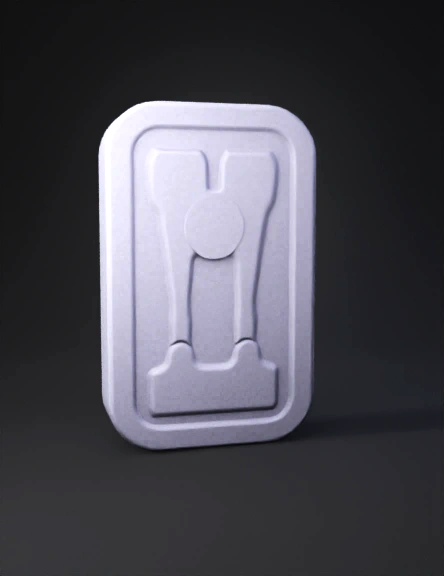
. Macroscopic Form & Structure The object is confirmed to be a monolithic, solid-body component, exhibiting no seams, fasteners, or part lines, indicating it was fabricated from a single piece of material. It maintains the form of a vertically oriented rectilinear prism with its four primary vertical edges softened by a large, constant-radius fillet. The new perspective views reinforce the object's proportions as slender and deep, designed for structural integrity. The most critical design principle observed is the deliberate contrast between the intricate, bilaterally symmetrical front face and the starkly minimalist back face, which is then broken by the functional asymmetry of its left and right lateral faces. II. The Front Face: The Functional "Nest" The new perspective view of the front reinforces the interpretation of this face as the primary functional interface, or "nest." The Bezel/Frame: This raised, continuous frame is shown to have a significant thickness, providing structural rigidity. Its flat top surface and sharp, perpendicular drop to the cavity floor are now seen with greater clarity, emphasizing its precise, machined quality. The Recessed Cavity & Internal Cutout: The depth of this cavity is substantial, confirmed to be more than half the object's total thickness. The new lighting model better accentuates the subtle fillets at the base of the interior walls of the cutout, which are typical features for manufacturability and stress reduction. The Central Sphere: The highlight on the sphere in the new view confirms its perfect curvature and seamless integration. It emerges from the cavity floor with a flawless tangential transition, giving the impression of a ball bearing perfectly fused into the substrate. Its position is undeniably deliberate, acting as a central pivot point or seating element for a mating part. III. The Lateral Faces: Asymmetrical Locating Features The new views provide a definitive look at the asymmetrical side features, solidifying their role as a keying system. The Left Face (Male Locator): The back-perspective view offers an unobstructed look at the protruding hemisphere. Its base is perfectly flush and co-planar with the flat side wall, emerging organically without any visible seam. This feature is a classic male locating pin, designed for positive engagement. The Right Face (Female Locator): The front-perspective view clearly shows that the semi-circular notch is cut directly into the raised bezel of the front face. It does not penetrate the main body behind the frame. This confirms its function as a localized, shallow female receptacle or clearance cut, designed to receive a corresponding pin. IV. The Back Face: Minimalist Reinforcement The new rear-perspective view confirms the utter simplicity of the back face. The shallow, recessed panel is perfectly centered. The lighting reveals that the floor of this recession is a pristine flat plane, and its walls, though shallow, are perpendicular to that plane, reinforcing the object's precise, geometric nature. V. Manufacturing & Material Implications (Expanded) These comprehensive views strongly suggest specific manufacturing processes and materials. Process: The object's complexity, particularly the deep front cavity with its integrated sphere and the features on multiple faces, points to one of two high-precision methods: Injection Molding: This is the most likely method for mass production. The consistent fillets, smooth surfaces, and potential for slight draft angles (implied) are hallmarks of molding. The design would necessitate a complex mold with at least one side-action slide to form the protruding hemisphere and another to form the side notch. CNC Machining: For prototyping or low-volume production, a 5-axis CNC mill could produce this part from a solid block of material. This would explain the exceptionally sharp edges (where not intentionally filleted) and the perfect geometric forms. Material: The uniform violet color and the soft, satin sheen of the surface are characteristic of a dyed engineering polymer. Materials like ABS (Acrylonitrile Butadiene Styrene), Nylon, or Polycarbonate would provide the required rigidity, dimensional stability, and high-quality surface finish. VI. Final Synthesis: A Component of Purpose This exhaustive, multi-angle analysis confirms that this object is not abstract. It is a single, purpose-built component from a larger mechanical assembly. Every feature—from the form-fitting nest and spherical seat on the front to the unambiguous male/female keying system on the sides—is deliberate. It is designed to hold a specific counterpart and to lock into a larger housing or device in one, and only one, possible orientation.
Detailed Info
Related Models
Enter invite code
Enter invite code to get credits!
 Anonymous1759937019


 Anonymous1759937019