3D Workspace
Home
Assets
Affiliate Program
Creator Program
Sign up/Log in
View Plans
DCC Bridge
biluta97506
12-05 06:32
Model Name
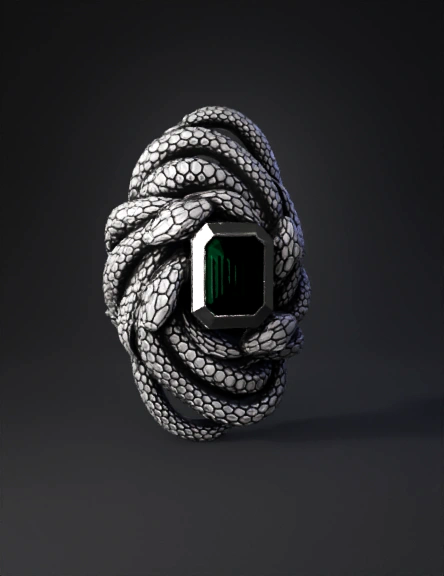
snake ring 3d model
Tags
emerald
gemstone
props
props realistic
props rendering
props rendering realistic
realistic
rendering
rendering realistic
snake ring
Prompt
Oversized fantasy half‑hand ring of sterling silver (925) featuring multiple intertwined snakes and a single central green emerald ~6.0 carats. The sculptural mass and gemstone must sit centered and facing forward on the dorsal surface of the finger when worn (i.e., visible from the front of the hand), not offset to the side. - Intent: wearable, high‑relief sculptural ring with an integrated secure setting for a valuable emerald. Prioritize readability of the composition from 50–100 cm and wearer comfort. Critical stone info (confirm before modelling) - Stone: Emerald, 6.0 carats. - Required from client: exact stone measurements in millimetres (length × width × depth) and cut type (emerald cut / cushion / oval / cabochon). Emeralds vary; do not model bezel/prong seat from carat alone — request actual mm. - Typical guidance (for reference only): a faceted emerald/oval of ~6 ct will often be in the ballpark of 11–14 mm long × 8–10 mm wide; depth depends on cut. Use the precise mm supplied by the client for final bezel dimensions. Orientation & fit (non‑negotiable) - Overall length (fingerwise, from proximal shank to tip of decorative element): 80 mm ±2 mm. - Maximum dorsal width: ~55–65 mm. - Max profile height above finger plane: 25–35 mm. - Inner diameter: model to supplied ring size (default example: 18.2 mm / US 8). Ask client to confirm. - Orientation requirement: explicitly design anti‑rotation features so the piece sits and remains centered on the dorsal/top of the finger: - Options: one wide asymmetric shank keyed to the underside of the finger; internal posterior flange or step that prevents forward rotation; gentle posterior relief that mates to the proximal finger; or light internal fins that “seat” the ring in the correct orientation. - Provide at least one mechanical anti‑rotation solution in the model and document how it ensures the front‑facing position. Gem setting & protection - Given a 6 ct emerald (fragile, valuable), recommend integrated bezel or mixed bezel + protective corner prongs (V‑style) for faceted emerald cuts. For cabochon, prefer fully enclosing bezel. - Bezel wall thickness: minimum 1.8–2.0 mm at critical edges; seat depth and inner profile must match the exact stone mm. For faceted stones, include clearance for girdle and small tolerance (~0.1–0.2 mm) for stone setting and adhesive if used. - If prongs are chosen, use rounded/protective prongs with reinforced shoulders; avoid thin prongs <1.6 mm. - Ensure stone is recessed slightly or cradled by snake coils to protect table/edges from direct impact. Sculptural design requirements - Snakes: multiple snakes of varying thicknesses (thin, medium, thick), interwoven to cradle and frame the emerald. Mix scale textures (fine scalation, smooth bands, raised ridges). Some heads may be subtly raised to form claws/bezel elements. - Readability: composition must read as centered frontal focal point — snakes should lead the eye to the emerald. - Avoid fragile protrusions <1.6 mm. Do not include open gaps that would trap skin or dirt against the finger. - Underside: smooth, slightly contoured interior next to skin; allow ~2–3 mm clearance beneath the heaviest dorsal mass to reduce weight and contact. Manufacturing & technical limits - Minimum feature thickness for sterling casting: decorative features ≥1.6–1.8 mm; structural shank areas ≥2.0 mm. Confirm with chosen foundry. - Include hollows/internal ribs to reduce weight by ~20–30% while preserving external silhouette. Ensure hollows have vents/drainage for casting. - Shrinkage allowance: model to foundry spec (typically 1.2–1.8% depending on foundry). Note clearly in delivery. - Prefer single castable unit where possible; otherwise supply clear assembly/weld points and instructions. Finish & patina - Finish plan: polished highlights on raised ridges (high shine); satin/matte fields for contrast; chemical patina/darkening in recesses to emphasize relief. Highly polished bezel around emerald. - Surface texture: mixed — high‑relief shiny scales and polished ridges against matte background fields. Deliverables - High‑res sculpt file (ZPR or ZTL) with layers for major components. - High‑poly OBJ with subdivisions preserved. - Watertight SLA printable STL optimized for 25–50 µm printing for lost‑wax casting. - CAD export (STEP/IGES) or clean retopologized mesh if required. - Orthographic views with full dimensions: top, side, front, underside. Include an annotated diagram showing how the ring sits on a finger (front/back labels) and indicating anti‑rotation features. - STL of separated parts if assembly is intended (with clear weld seams). - Render passes: front beauty render, side render showing profile and height, underside render showing comfort fit. - Notes file: alloy (Sterling 925), confirmed inner diameter, exact stone mm and cut, recommended bezel/prong specs, and tolerances used. Prototyping & QA - Prototype print: SLA 25–50 µm. Orient so detailed frontal faces are support‑minimal; supports acceptable on underside. - Test fit prototype on anatomy model to confirm orientation and comfort; verify that the stone reaction area (impact, clearance) is acceptable. - Post‑casting: refine seat, set stone, secure prongs/bezel, apply selective patina, final polish.
Detailed Info
Related Models
Enter invite code
Enter invite code to get credits!
 biluta97506


 biluta97506