3D Workspace
Home
Assets
Affiliate Program
Creator Program
Sign up/Log in
View Plans
DCC Bridge
Anonymous1764904975
12-05 03:44
Model Name
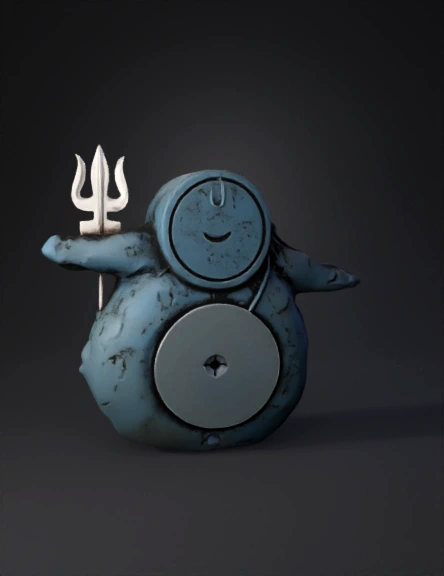
blue blob creature 3d model
Tags
3d printing
3d printing clay
blue blob creature
clay
creatures animals
creatures animals 3d printing
creatures animals 3d printing clay
creatures animals clay
Input
Prompt
PRIMARY GOAL: Create a watertight, 3D-printable solid model of the small wall-mounted statue visible in the image (front view). Output format: STL (manifold, no non-manifold edges). Target final printed height: 80 mm (Adjust scale later in slicer if needed). MODEL DESCRIPTION (high detail — include every small detail): - Overall shape: a seated small deity/statue with a central body, two raised arms, a small round head with subtle facial features, and a small trident (trishula) held in the right hand. The statue should appear slightly stylized but anatomically consistent for a small decorative statuette. - Face: low-relief facial features (eyes, nose, mouth) with clear separations; preserve the small smile/marking visible on the head in the photo; ensure minimum detail thickness ≥ 0.8 mm so features print clearly. - Hands & trident: the trident has three prongs; generate crisp prong tips with internal fillet where prong meets shaft. Shaft diameter at least 2.5 mm for print strength (scale dependent). Fingers should be simplified but readable; any very thin parts must be thickened to printable minimums. - Ornamentation: reproduce the small round smiling disc / halo behind the head (visible as a bright face/emoji), including its raised outline and any texture. If the disc is fragile, make it thicker (min 2.5–3.0 mm). - Surface texture: generate a slightly rough, hand-sculpted texture on the statue surface (subtle noise/stone clay effect). Do not create extremely high-frequency noise that will exceed STL resolution. - Base/back: include a flat backing plate centered on the statue that allows the model to be wall-mounted or glued. Backing plate thickness 3.0–4.0 mm, with a 5 mm diameter countersunk hole (M4 screw friendly) centered vertically — include a 45° countersink for a flush screw head. - Hollowing & drainage: create the model as a solid shell but hollow to reduce material (see Hollowing section below). Add an internal drain/escape hole of 6 mm at the bottom for resin removal or filament escape if requested. - Mounting alignment: keep the statue’s back flat and orthogonal to the vertical axis so it can be printed in a supported orientation and glued to a wall backing. - Topology: produce clean topology, quad-dominant where possible, with smart retopology for clean edges and minimal triangle noise. Ensure no inverted normals, no duplicate vertices, and no non-manifold geometry. - Scale & units: generate model in millimeters. Final exported STL units should be mm. PRINTABILITY CONSTRAINTS & MINIMUMS: - Minimum feature width: 0.8 mm - Minimum wall thickness: 2.5 mm (for thin decorative parts, 3.0 mm recommended) - Smallest hole diameter: 1.5 mm (for structural holes 3.0 mm recommended) - Ensure overhangs limited to <= 60° where possible; Tripo should add small chamfers on extreme overhang edges. TEXTURING & MATERIAL MAPS: - Generate a clean diffuse/Albedo texture (medium resolution) but do NOT bake excessive normal map detail that would create tiny overhangs below minimum printable size. Provide a plain color option for single-color printing. OUTPUT: - Primary export: STL (watertight, manifold) for FDM printing. - Secondary export: GLB with PBR textures for previewing (optional). - Provide a “low-poly” version (smart low poly) and an “ultra” detailed version. The low-poly should be printable without heavy supports. ADDITIONAL NOTES: - Create small fillets on sharp edges to improve print strength (0.6–1.0 mm). - Place hidden internal support structures where very thin protrusions occur so they print stronger (internal ribs inside hollow shell). - Ensure the trident and any thin protrusions are printable as a single, non-separate object (no loose or floating islands). - Tag the model: “wall_statue, trident, small_deity, printable, STL, mm, mount_hole”. PRIORITIZE: 1) Manifold watertight STL, 2) Minimum printable thicknesses, 3) Preservation of recognizable small details (face, trident prongs), 4) Clean topology for easy slicing.
Detailed Info
Related Models
Enter invite code
Enter invite code to get credits!
 Anonymous1764904975


 Anonymous1764904975