3D Workspace
Home
Assets
Affiliate Program
Sign up/Log in
?
Upgrade
DCC Bridge
Anonymous1761260677
11-09 18:09
Model Name
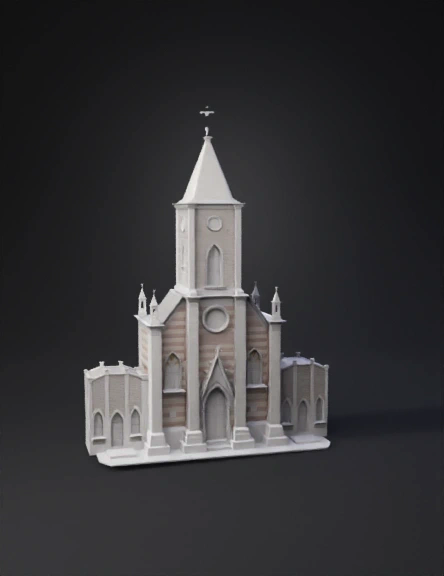
church facade 3d model
Tags
3d printing
3d printing realistic
architecture
architecture 3d printing
architecture 3d printing realistic
architecture realistic
church facade
geometric
realistic
Input
Prompt
Project Objective: Generate a 3D high-relief model of the Ráquira church facade, based on the provided 2D image. Core Design Philosophy: The model must function as a "positive" shape (like a large coin or stamp) intended for creating a "negative" mold. The final object is a single, monolithic piece with a perfectly flat back surface. Key Geometric & Molding Constraints: Flat Back Plane: The model must have a single, perfectly flat back (Z-plane), serving as the base from which all features originate. Strictly Positive Relief: All details of the church (bricks, windows, tower, doorway, etc.) must protrude exclusively forward from this flat back plane. No Undercuts (Critical for Frontal Extraction): This is the most critical constraint. The model must be 100% free of undercuts, recesses, or any "inlay" geometry. It must be designed for a simple, linear, frontal extraction from a mold. All vertical surfaces must have a positive draft angle (even if minimal) relative to the pull direction (Z-axis). Handling Recessed Features: The main doorway, which appears recessed in the 2D image, must be translated into a forward-protruding relief. It should be modeled at a lower positive height than the surrounding walls to create the illusion of depth, while still maintaining a positive draft angle for extraction. Technical Specifications: Profile: The model's outer boundary should be defined by a clean coronal (frontal) profile or silhouette of the facade. Minimum Thickness: The thinnest sections of the relief (e.g., the lowest parts of the doorway relief) must have a minimum material thickness of 4mm measured from the flat back plane. Detail Focus: All modeling detail is concentrated on the frontal surface. The back and sides (defined by the coronal cut) are functional and can be smooth. Mesh Optimization: The resulting mesh should be optimized. Reduce the vertex/polygon count on large, flat surfaces (especially the back plane and any flat wall sections) while preserving high mesh density only in areas of complex detail and curvature (e.g., decorative edges, window frames, textures).
Detailed Info
Related Models
Enter invite code
Enter invite code to get credits!
 Anonymous1761260677


 Anonymous1761260677