3D Workspace
Home
Assets
Affiliate Program
Creator Program
Sign up/Log in
View Plans
DCC Bridge
Anonymous1774125859
03-21 20:51
Model Name
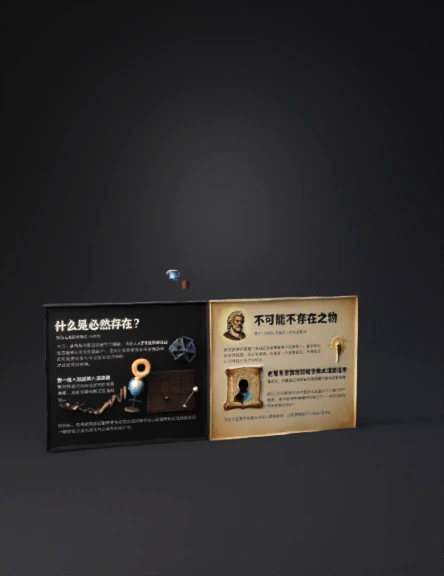
philosophy poster 3d model
Tags
abstract symbol
abstract symbol concept art
abstract symbol concept art stylized
abstract symbol stylized
concept art
concept art stylized
stylized
universe
Prompt
Script Breakdown SCENE 1: Opening Hook (15 seconds) [VISUAL: Black screen fading into a starry universe. A single question appears in elegant white text] TEXT ON SCREEN: "Why does anything exist at all?" [VISUAL: Camera slowly zooms through space toward Earth] NARRATOR (V.O.): "Throughout human history, one question has haunted philosophers, scientists, and ordinary people alike. Why is there something rather than nothing?" SCENE 2: Introducing Key Terms (30 seconds) [VISUAL: Split screen showing two contrasting images] [LEFT SIDE - Dark void with question marks] [RIGHT SIDE - Vibrant world with objects, people, nature] TEXT ON SCREEN: "Contingent Being vs. Necessary Being" NARRATOR (V.O.): "To understand this mystery, we must first understand two fundamental concepts: contingent beings and necessary beings." [VISUAL: An everyday object appears - a coffee cup] NARRATOR (V.O.): "A contingent being is something that exists, but could have not existed. This coffee cup you're holding — it wasn't necessary. It was created, it can be destroyed, and its existence depends on countless other factors." [VISUAL: The coffee cup fades, replaced by a question mark glowing with golden light] NARRATOR (V.O.): "But a necessary being — now that's something entirely different." SCENE 3: What is Necessary Being? (45 seconds) [VISUAL: Golden light expands from the question mark, filling the screen] TEXT ON SCREEN: "NECESSARY BEING" "That which cannot NOT exist" NARRATOR (V.O.): "A necessary being is something that exists by its very nature. It doesn't depend on anything else for its existence. It cannot be otherwise. It simply must exist." [VISUAL: Abstract geometric shapes dancing in perfect harmony] NARRATOR (V.O.): "Think of mathematical truths. Two plus two must equal four. It couldn't be otherwise. The number three — it simply exists necessarily. But what about physical reality? Does anything in our universe work this way?" [VISUAL: Transition to philosophical imagery — ancient scrolls, Greek columns] NARRATOR (V.O.): "This question has driven philosophical inquiry for millennia." SCENE 4: Historical Perspectives (60 seconds) [VISUAL: Animated portrait of Aristotle appears] TEXT ON SCREEN: "Aristotle's Prime Mover" NARRATOR (V.O.): "Aristotle proposed the concept of the 'Prime Mover' — an eternal, necessary being that set everything else in motion. This being doesn't change, doesn't depend on anything, and is pure actuality." [VISUAL: Transition to medieval library setting, quill writing on parchment] TEXT ON SCREEN: "Thomas Aquinas - The Five Ways" NARRATOR (V.O.): "Thomas Aquinas, the medieval philosopher and theologian, developed this further in his famous 'Five Ways.' He argued that we must arrive at a first cause — a necessary being — to explain why anything exists at all." [VISUAL: Chain of dominoes falling, leading to an unmoved first domino] NARRATOR (V.O.): "Everything that exists is caused by something else. But there must be a first cause — something uncaused, something necessary." SCENE 5: The Ontological Argument (45 seconds) [VISUAL: Portrait of Anselm of Canterbury] TEXT ON SCREEN: "Anselm's Ontological Argument" NARRATOR (V.O.): "Perhaps the most fascinating argument comes from Anselm of Canterbury. He proposed what we call the Ontological Argument — a purely logical proof." [VISUAL: Abstract logic symbols and concepts floating] NARRATOR (V.O.): "Imagine the greatest being you can conceive. Now, would it be greater to exist only in your mind, or to exist in reality too? A being that exists in reality is greater than one that exists only in the mind. Therefore, God — the greatest being conceivable — must exist necessarily." [VISUAL: Logic puzzle pieces clicking together] NARRATOR (V.O.): "Of course, this argument has sparked centuries of debate. Critics like Kant argued that existence isn't a predicate — it doesn't add to the concept of a thing." SCENE 6: Modern Perspectives (45 seconds) [VISUAL: Transition to modern university setting] TEXT ON SCREEN: "Contemporary Philosophy" NARRATOR (V.O.): "Today, philosophers continue to grapple with these questions. Some, like Alvin Plantinga, have revived the ontological argument with modern modal logic." [VISUAL: Abstract visualization of multiple universes/possibilities] NARRATOR (V.O.): "Others explore the anthropic principle — the idea that the universe's constants seem perfectly tuned for life, suggesting a necessary designer." [VISUAL: Split screen showing scientific and philosophical imagery] NARRATOR (V.O.): "Meanwhile, physicists explore quantum mechanics and multiverse theories, asking whether necessity might be found in the laws of physics themselves." SCENE 7: The Deeper Question (30 seconds) [VISUAL: Contemplative imagery — person staring at stars, abstract patterns] TEXT ON SCREEN: "Does the necessity of being apply to you?" NARRATOR (V.O.): "But here's where it gets personal. If there is a necessary being — something that simply must exist — what does that mean for us?" [VISUAL: Human silhouette with inner light] NARRATOR (V.O.): "Are we merely contingent accidents in a cosmic accident? Or do we, too, participate in something necessary — some fundamental aspect of reality that cannot be otherwise?" SCENE 8: Conclusion (30 seconds) [VISUAL: Return to the starry universe, but now with warmth and meaning] TEXT ON SCREEN: "The question remains open..." NARRATOR (V.O.): "The existence of necessary being remains one of humanity's greatest open questions. Science explains how things work. Philosophy asks why they exist at all." [VISUAL: Question mark transforms into an open door of light] NARRATOR (V.O.): "Whether you find your answer in theology, philosophy, science, or personal reflection, the question itself points to something profound — the mystery of being itself." [VISUAL: Fade to black] TEXT ON SCREEN: "What do you think exists necessarily?" Production Notes Visual Style Recommendations: Clean, minimalist 2D animation Warm color palette (golds, deep blues, soft whites) Smooth transitions between concepts Abstract visualizations for philosophical ideas Occasional historical imagery for context Audio: Calm, contemplative background music Clear, measured narrator voice Soft sound effects for transitions Text Overlays: Key terms appear as emphasis Quote highlights fade in elegantly Keep text minimal — let visuals tell the story
Detailed Info
Related Models
Enter invite code
Enter invite code to get credits!