3D Workspace
Home
Assets
Affiliate Program
Creator Program
Sign up/Log in
View Plans
DCC Bridge
gaboremem8
10-12 12:25
Model Name
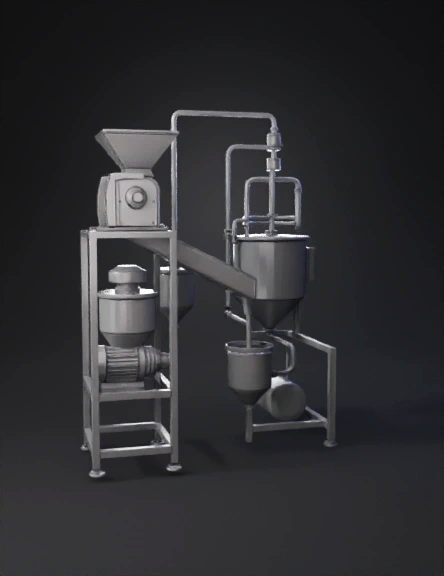
sugarcane juice extractor 3d model
Tags
machine
machine realistic
machine simulation
machine simulation realistic
realistic
simulation
simulation realistic
sugarcane
Input
Prompt
Machine Overview Add a gravity feed trough under the roller crusher: Place a wide, shallow rectangular trough directly beneath the roller outlet so crushed cane juice drops straight into it. Trough should be slightly concave or have a shallow center gutter to keep flow concentrated. Slope the trough downward at ~5–8° toward the collector tank’s inlet. Replace the short pipe currently under the roller with the trough→collector section: Extend the trough forward and down until its outlet sits directly over the top opening of the first (primary) collector tank (the small conical tank at lower center). Where the trough meets the tank, show a flared lip or short open spout so juice visibly pours into the tank (no enclosed piping). Keep a small clearance gap (~5–10 mm visible) between trough end and tank rim or show the spout inserted slightly into tank mouth — whichever reads clearer. Make the flow visibly one-way (gravity): Emphasize the slope and add three short downward motion lines (small, simple strokes — not arrows) along the trough or at the spout to show downward flow. Remove any return pipes or loops that would imply backflow from that collector back to the crusher. Connect rest of system visually but keep it closed-type: Keep the existing pipe connections from the collector tank to the evaporator/processing tank as they are, but ensure none of them loop back to the roller. If there’s a pump later in the system, show it downstream of the collector to indicate suction/transfer after gravity collection. Visual styling & clarity: Make the trough material the same as other juice-contact parts (SUS304 look: subtle reflected highlights). Keep line weights consistent; slightly darker outline on the trough and spout helps it read as a new addition. Remove or tone down any small pipes that clutter the area under the rollers so the trough and the collector tank opening are clear. Suggested dimensions (visual scale for the drawing) Trough width: same as roller crusher outlet — approx 25–30 cm in drawing scale. Trough depth: 4–6 cm (shallow). Slope: 5–8° down toward the tank. Spout length: 3–5 cm beyond trough to show a visible pour into tank. This machine integrates: Extraction (roller-type juice crusher) Filtration (primary and secondary filters) Concentration chamber (evaporator/condenser system) Collection and storage system It’s designed for compact operation — ideal for small-scale sugarcane processing (5–10 L/hr). ⚙️ II. Major Components and Functions No. Part Function Approx. Dimension (L × W × H, cm) Notes 1 Feed Hopper Funnel where sugarcane stalks are fed into the rollers. 30 × 30 × 25 Stainless steel, tapered walls 2 Three-Roller Crushing Assembly Extracts juice from sugarcane by compression between rollers. 40 × 25 × 30 Mild steel rollers, rubber-coated or stainless finish 3 Gearbox & Motor Drive Transfers power to rollers; speed ~50 rpm. Motor: 25 × 20 × 25 1.0–1.5 HP electric motor, chain-driven 4 Juice Collection Tray Collects extracted juice below rollers. 25 × 25 × 10 Sloped bottom to direct juice into pipe 5 Primary Filter (Settling Tank) Separates bagasse fibers and impurities. Ø20 × 40 Simple mesh and gravity filtration 6 Heater Tank / Evaporator Main heating vessel for juice concentration. Ø45 × 60 25–30 L capacity; double-walled for steam or LPG heating 7 Condenser / Vapor Tube Condenses evaporated moisture into water output line. Ø5 × 60 (pipe) Stainless tubing; mounted overhead 8 Concentrate Collector Tank Collects thickened molasses/syrup from evaporator outlet. Ø25 × 40 Stainless steel; outlet valve for bottling 9 Storage / Feed Drum (LPG or Electric Heater) Houses the heating source (steam or LPG line). Ø30 × 40 Optional: insulated LPG tank or heating coil system 10 Control Box Manages temperature, mixing speed, and heating duration. 15 × 10 × 8 Digital or analog thermostat and relay switches 🔁 III. Process Flow Feeding & Extraction Sugarcane stalks are inserted into the hopper. The roller crusher squeezes out the juice, which flows into the collection tray. Filtration Juice passes through the primary filter tank, removing coarse fibers and sediments. Evaporation / Concentration Filtered juice is pumped into the heating tank (evaporator). Heat (from LPG burner or electric element) evaporates water from juice. Steam exits via the vapor condenser, and condensed water is released separately. Concentration Control Temperature and time are managed via the control panel (e.g., 80–90°C for ~45–60 minutes). Collection The concentrated syrup (molasses) flows into the collector tank. The output is ready for cooling and bottling. 📏 IV. Overall Dimensions Parameter Value Overall Height 140–150 cm Overall Length 110–120 cm Overall Width 55–60 cm Weight (est.) 65–75 kg Material Food-grade Stainless Steel (SUS304) Production Rate 5–10 L/hr concentrated syrup Power Requirement 220 V AC, 1–1.5 HP motor Heating Source LPG burner or electric heating coil
Detailed Info
Related Models
Enter invite code
Enter invite code to get credits!