3D Workspace
Home
Assets
Affiliate Program
Sign up/Log in
?
Upgrade
DCC Bridge
Anonymous1760230443
11-05 20:05
Model Name
open book 3d model
Tags
open book
props
props realistic
props rendering
props rendering realistic
realistic
rendering
rendering realistic
venice
Prompt
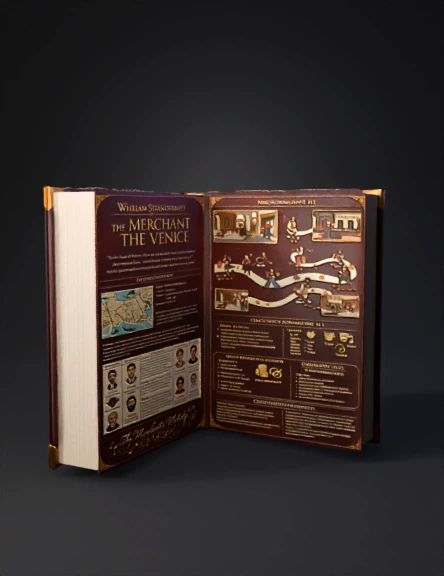
The Merchant of Venice: A Comprehensive Summary and Analysis WILLIAM SHAKESPEARE'S THE MERCHANT OF VENICE "In the heart of Venice, where money is king... a friendship is priceless." "To win a heart, a fortune must be risked." "But to fund the venture... a dangerous bargain must be struck." "In a court of law... will there be any mercy?" WHEN FRIENDSHIP DEMANDS THE ULTIMATE SACRIFICE There will be justice. And there will be a price. Context and Setting * Author: William Shakespeare * Genre: Comedy (often categorized as a "Problem Play" due to its dark themes) * Written: 1596–97 * Settings: The play alternates between two key locations: * Venice: A bustling, multicultural center of commerce and trade, governed by strict laws. It represents a world of business, finance, and legal disputes. * Belmont: The fictional estate of the wealthy heiress Portia. It is a world of romance, music, and fairytale logic, standing in stark contrast to the harsh realities of Venice. Key Characters | Character | Description | Key Role | |---|---|---| | Antonio | The titular merchant of Venice. A wealthy and respected Christian who is nevertheless afflicted by a deep melancholy. He is fiercely loyal to his friends but openly antisemitic towards Shylock. | Acts as the guarantor for Bassanio's loan, putting his own life at risk by agreeing to forfeit a "pound of flesh." | | Bassanio | A noble but financially reckless Venetian. He is a dear friend of Antonio and is determined to win the hand of the wealthy and beautiful Portia. | Secures the loan from Shylock to fund his courtship of Portia, inadvertently setting the central conflict in motion. | | Shylock | A wealthy Jewish moneylender. He is a complex and tragic figure who has suffered from the prejudice and insults of Venice's Christian community, particularly Antonio. | Lends Bassanio the money but demands a pound of Antonio's flesh as collateral, seeking revenge for years of abuse. | | Portia | A wealthy, intelligent, and resourceful heiress from Belmont. She is bound by her late father's will to marry the suitor who chooses the correct of three caskets. | Disguises herself as a male lawyer named Balthazar to save Antonio's life during the pivotal trial scene. | | Jessica | Shylock's daughter. She feels constrained by her life with her father and longs for a different existence. | Elopes with the Christian Lorenzo, stealing a significant amount of her father's gold and jewels, which deepens Shylock's rage. | | Gratiano | A friend of Antonio and Bassanio. He is known for being talkative, boisterous, and somewhat crude. | Accompanies Bassanio to Belmont and falls in love with Portia's lady-in-waiting, Nerissa. | | Nerissa | Portia's clever and loyal lady-in-waiting. | Marries Gratiano and accompanies Portia to Venice, disguised as Balthazar's clerk. | | Lorenzo | A friend of Antonio and Bassanio. | Elopes with Jessica and is later revealed to be the heir to Shylock's fortune. | Plot Overview The Merchant of Venice is set largely in the wealthy city-state of Venice, a hub of Renaissance trade. Antonio, a prosperous merchant, is unable to directly fund his close friend Bassanio's quest to court the beautiful heiress Portia of Belmont, as his own fortunes are tied up in ships at sea. Antonio sends Bassanio to borrow the money from Shylock, a Jewish moneylender, on his credit. Shylock, who has suffered years of insults from Antonio, agrees to the loan but proposes a sinister bond: if the debt is not repaid on time, he will claim a pound of Antonio's flesh. Bassanio secures the money and travels to Belmont. There, Portia's suitors must choose from three caskets—gold, silver, or lead—to win her hand. After two others fail, Bassanio chooses the correct lead casket and wins Portia's love. Meanwhile, Shylock's daughter, Jessica, elopes with Lorenzo, a Christian, taking a substantial amount of her father's wealth. Enraged by this betrayal and the news that Antonio's ships have been lost at sea, Shylock is determined to exact his revenge. He brings Antonio before the Duke of Venice to demand his pound of flesh. The climax occurs in the courtroom, where Portia, disguised as a young male lawyer named Balthazar, arrives to defend Antonio. She makes an impassioned plea for mercy, which Shylock rejects. Conceding the bond is legal, she cleverly turns the tables, stating that the contract allows for flesh but not a single drop of blood. Trapped by this logic and accused of plotting against a Venetian's life, Shylock is defeated. His fortune is seized, and he is forced to convert to Christianity. The play concludes in Belmont, where Portia reveals her disguise, Antonio's ships are reported safe, and the newly married couples celebrate. Full Plot Summary by Act Act I: The Bond is Struck In Venice, the merchant Antonio confesses to his friends that he is overcome with a sadness he cannot explain. His dear friend Bassanio arrives and asks for a loan of 3,000 ducats to travel to Belmont and present himself as a worthy suitor to the wealthy heiress Portia. Antonio's capital is tied up in his merchant ships, so he authorizes Bassanio to secure a loan on his credit. Bassanio approaches Shylock, who agrees to the loan but, in a "merry sport," proposes a chilling condition: if the loan is not repaid in three months, Shylock will be entitled to cut a pound of Antonio's flesh. Confident his ships will return in time, Antonio agrees to the bond. Act II: Love, Elopement, and Caskets In Belmont, Portia complains to her maid, Nerissa, about the terms of her father's will, which forces her suitors to choose from one of three caskets—gold, silver, or lead. The Princes of Morocco and Arragon both fail. Meanwhile, in Venice, Shylock's daughter Jessica elopes with Lorenzo, a Christian, taking a casket filled with her father's jewels and money. Shylock is enraged by his daughter's betrayal and the loss of his fortune, fueling his desire for revenge. Act III: A Winner and a Loser Shylock learns that Jessica is recklessly spending his stolen money. This news, combined with rumors of Antonio's lost ships, pushes him over the edge. In a powerful speech, he defends his desire for revenge, arguing that a Jew shares the same humanity as a Christian ("Hath not a Jew eyes?"). Back in Belmont, Bassanio chooses the correct lead casket and wins Portia's hand. Their celebration is cut short when a letter arrives: all of Antonio's ships have been lost, and Shylock is demanding his pound of flesh. Bassanio and Gratiano rush back to Venice, while Portia and Nerissa secretly decide to follow, disguised as men. Act IV: The Trial In the Venetian court, Shylock is deaf to all pleas for mercy. A young, brilliant lawyer named Balthazar (Portia in disguise) arrives. She eloquently argues for mercy, but when Shylock remains unmoved, she concedes the bond is legal. As Shylock prepares his knife, Portia stops him, pointing out that the bond grants him flesh but no blood. Trapped, Shylock is charged with conspiring against the life of a Venetian citizen. The penalty is the confiscation of his wealth. The Duke spares Shylock's life, but Antonio's conditions are harsh: Shylock must convert to Christianity and leave his estate to Jessica and Lorenzo. Utterly broken, Shylock agrees and departs. Act V: Resolution in Belmont The final act returns to Belmont. Portia and Nerissa arrive home just before their husbands. They playfully accuse their husbands of being unfaithful for giving away their wedding rings (which they had, in disguise, demanded as payment). After some lighthearted quarreling, Portia reveals that she was the lawyer Balthazar. The play ends with good news: three of Antonio's ships have returned safely, and the three happy couples prepare to celebrate. Major Themes and Analysis Justice vs. Mercy This is the central conflict. Shylock demands strict, literal justice as a means of revenge, while Portia champions mercy as a higher, divine virtue. However, the "mercy" shown to Shylock—forcing his conversion—is seen by modern audiences as incredibly cruel. Paradoxically, those who want Shylock to be merciful show him little mercy once he has been defeated. The play questions whether the Christian characters truly understand the concept they preach and suggests mercy should be offered even to those who may not "deserve" it. Prejudice and Intolerance The play is a stark depiction of the antisemitism prevalent in Renaissance Europe. Shylock's villainy is not baseless; it is a reaction to the constant abuse and dehumanization he suffers from Antonio and others. He is limited to moneylending, lives in a ghetto, and is publicly insulted. His famous "Hath not a Jew eyes?" speech is a powerful plea for his shared humanity, forcing the audience to see him as a victim as well as a villain. His desire for revenge stems from the personal and systemic prejudice he has faced. Appearance vs. Reality This theme is woven throughout the play. The motto on the lead casket, "All that glisters is not gold," proves true. The caskets themselves hide their true value, and characters like Portia, Nerissa, and Jessica use disguises to achieve their goals. Bassanio appears wealthy but is in debt. While Shylock appears to be the play's villain, his suffering elicits the audience's sympathy. Shakespeare uses these deceptions to reinforce the idea that true worth is found beneath the surface. The Value of Life and Money (Worth) The play constantly weighs human life, love, and loyalty against commercial interests. The bond for a "pound of flesh" is the ultimate example, reducing a human life to a commodity. While Venice is obsessed with wealth, the Belmont plot suggests true value lies in love and loyalty. Bassanio and Antonio risk everything for friendship, Portia offers her fortune to save Antonio, and Shylock values revenge over a threefold repayment of his loan. Gold, silver, and jewels are only valuable because of the feelings behind them. Lack of Control Few characters are in control of their own destinies. Antonio's fortune is at the mercy of the seas. Portia cannot choose her husband due to her father's will. Bassanio is controlled by his debts. Jessica is constrained by her father's overbearing nature. Shylock is subject to the city's discriminatory laws. Each character attempts to overcome these forces with mixed results. Symbols and Motifs Symbols * Gold: Represents wealth, status, and power. Bassanio needs it to appear worthy, Shylock uses it to exert power, and Jessica steals it to rebel. Yet the play ultimately argues that true worth—love, loyalty, life—cannot be measured in gold. * Flesh: Symbolizes life itself. By demanding a pound of Antonio's flesh, Shylock demands his very life, not as payment for a loan but as retribution for years of suffering. Antonio's willingness to offer his flesh demonstrates the depth of his sacrifice for Bassanio's happiness. * Rings: Represent love, commitment, and loyalty between partners. Portia tests Bassanio's loyalty with the ring she gives him. Shylock is undone by the rumor that Jessica traded her mother's ring for a monkey, viewing it as a profound disrespect to her parents' bond. Motifs * Ships: As a city built on water, Venice relies on ships for trade and transportation. They represent mobility, fortune, and risk. Antonio's wealth is tied to his ships, and their reported loss is what endangers his life. * Disguise: Disguise is a key plot device. Jessica escapes her father's house dressed as a boy, and Portia and Nerissa disguise themselves as men to intervene in the trial and later test their husbands. This motif plays on the theme of appearance versus reality and was also a practical element of Elizabethan theatre, where male actors played all female roles. Literary Devices * Allusion: The play is rich with biblical and classical allusions. Characters reference stories from the Bible to debate ethics and draw on classical mythology (like Jason and the Golden Fleece) to illustrate their points, adding depth for an educated audience. * Wordplay: Shakespeare uses extensive wordplay, especially puns, to add humor and complexity. Portia puns on the word "will" (her desire vs. her father's legal document). The riddles on the caskets are another form of wordplay. Such devices reinforce the theme that surface meanings can be deceptive. 9 Interesting Facts * Famous Phrases: The play is the origin of "all that glitters is not gold," "a pound of flesh," and "with bated breath." * Italian Source: The main source was likely an Italian story from Il Pecorone ("The Simpleton"), which had a similar plot. * A Royal Favorite: King James I enjoyed the play so much that he commanded a second performance just two days after the first in 1605. * Nazi Propaganda: The character of Shylock was tragically used by the Nazis, who staged over 50 productions to promote their antisemitic ideology. * Invented Name: Shakespeare is credited with inventing the name Jessica, possibly from the biblical name Iscah. * Performance in the Venice Ghetto: In 2016, to mark the 500th anniversary of the Venetian Ghetto's formation, the play was performed in its actual historical setting for the first time. * Ruth Bader Ginsberg's Mock Trial: In 2016, the late Supreme Court Justice presided over a mock appeals trial that overturned the original verdict, restoring Shylock's property. * Lost Orson Welles Film: Director Orson Welles started a film adaptation in 1969 that was never completed. * A "Problem Play": Though categorized as a comedy, its dark themes and disturbing treatment of Shylock cause many critics to label it one of Shakespeare's "problem plays." The Merchant's Melody (To the tune of "Someone Like You" by Adele) (Verse 1) In Venice's streets, where commerce runs deep Antonio's sadness, a story to keep Bassanio needs money to win Portia's heart And Shylock's revenge is about to start (Chorus) I heard that you made a bond so cold A pound of flesh, a tale to be told With prejudice burning and justice so tight In Shakespeare's world of dark and light (Verse 2) Portia disguised as a lawyer so brave Her wit and her wisdom would Antonio save The trial unfolds with such dramatic flair A test of mercy beyond compare (Chorus) I heard that you demanded your due A contract of hatred, so bitter and true With Jessica gone and your anger so strong In a world where you felt you didn't belong (Bridge) Hath not a Jew eyes? Hath not a Jew's heart Feeling the pain of being set apart A pound of flesh, a bond of despair A story of justice beyond compare (Final Chorus) Sometimes it lasts in legal design Sometimes it hurts when the law's a fine line But you'll always remember this Shakespearean art The Merchant of Venice, close to my heart Questions for Discussion Questions about the Story: * Is Shylock a villain driven by greed, or a tragic figure responding to the prejudice he has endured? Explain your reasoning. * How does Portia's casket test for her suitors reflect her father's values and what he wanted in a son-in-law? Questions about Plot, Setting, and Characters: * Contrast the settings of Venice and Belmont. What do these two different worlds represent in the play? * Analyze the theme of mercy. How is it discussed, and is it applied equally to all characters in the play's conclusion?
Detailed Info
Related Models
Enter invite code
Enter invite code to get credits!
 Anonymous1760230443


 Anonymous1760230443