3D Workspace
Home
Assets
Affiliate Program
Creator Program
Sign up/Log in
View Plans
DCC Bridge
sbesu95
03-04 11:10
Model Name
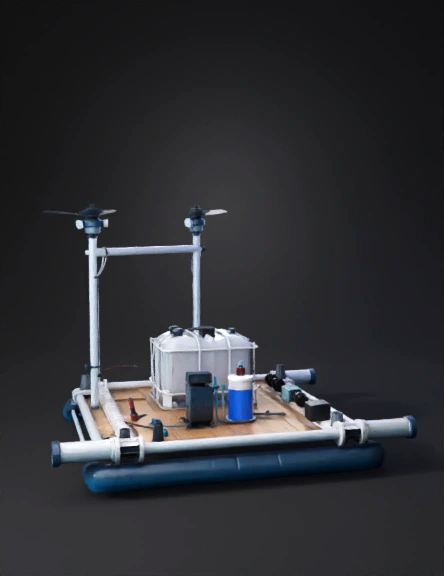
aquatic drone raft 3d model
Tags
catamaran
raft
realistic
rendering
rendering realistic
rudder
submersible
vehicle
vehicle realistic
vehicle rendering
vehicle rendering realistic
waterproof
Prompt
The Technical Design Blueprint 1. The Hull (The Raft) To ensure stability while carrying a water tank and battery, a catamaran (twin-hull) design is best. Pontoons: Two parallel 1-meter lengths of 40 mm PVC pipe. Aero-Dynamics: 40 mm PVC cones (reducers or 3D-printed caps) on all four ends to reduce water resistance. Structure: Connect the two pontoons using 40 mm T-pieces and cross-bars to create a "ladder" frame. This platform will hold your electronics box and the sample tank. 2. Propulsion & Steering Motor: A waterproof brushless motor with a 3-blade propeller. Steering: You can use a differential thrust setup (two motors, one on each hull) which eliminates the need for a physical rudder, making it more maneuverable in weedy river water. 3. The Sampling System (The Payload) Intake: A weighted 12V submersible pump or a peristaltic pump (better for maintaining sample integrity). Storage: A small HDPE tank (approx. 500ml–1L) mounted in the center of the raft. Sensors: In-situ probes for pH, TDS (Total Dissolved Solids), and Dissolved Oxygen (DO). These provide real-time data before the physical sample is even taken. 🛰️ Navigation & Control (Drone Integration) By using a Flight Controller (e.g., Pixhawk or Ardupilot), your raft gains "Rover" capabilities: GPS Tagging: Every time the pump activates, the GPS logs the exact coordinates ( ). Contamination Mapping: By measuring TDS/pH at different distances from a discharge point, you can calculate the Pollution Gradient. Telemetry: Real-time data is sent back to your ground station (laptop/tablet). 🧪 Data Workflow & Lab Integration Stage Action Output Field GPS + Sensor Log Digital CSV file with pH/TDS/Location Lab Chemical/Microbial Analysis Detailed Lab Report Final Data Merging A heat map showing contamination levels vs. distance Note on "Mother Printer": To automate the printout, you can set up a Cloud-connected API (like Google Sheets or a custom Python script). Once the lab results are typed in, the system matches them to the GPS coordinates and automatically sends a formatted report to your office printer. Suggested Components for your Shopping List: Controller: FlySky FS-i6 (Remote) + Pixhawk 4 (Brain). Power: 3S or 4S LiPo Battery (12V compatible). Pump: 12V DC Diaphragm Pump (Self-priming). Sensors: Gravity Analog pH & TDS sensor kits for Arduino/Raspberry Pi. Would you like me to draft a wiring diagram or a Python script that helps map the GPS coordinates to the contamination levels? AI can make mistakes, so double-check responses Would you like me to draft a wiring diagram or a Python script that helps map the GPS coordinates to the contamination levels?Yes This blueprint provides the wiring logic for your PVC raft and a Python script to automate your contamination mapping. 🔌 1. Wiring & Control Logic To integrate a 12V pump with a drone flight controller (like a Pixhawk), you must use a Relay or an Electronic Speed Controller (ESC) to prevent damaging the low-voltage electronics. Arduino Forum Arduino Forum +1 Main Power: Connect your 3S/4S LiPo Battery to a Power Module which regulated 5V to the Pixhawk while passing the full battery voltage to the motors and pump. The Pump: Connect the 12V Pump's positive wire to a 5V Relay Module. Connect the Relay’s signal pin to a PWM output port on the Pixhawk (e.g., AUX 1). Navigation: Plug your GPS/Compass module into the dedicated GPS port. Sensors: Connect your pH/TDS probes to an Arduino or a companion computer (like a Raspberry Pi) to log data alongside the GPS coordinates. Arduino Forum Arduino Forum +6 🐍 2. Python Mapping Script This script uses the Folium library to create an interactive map that visualizes contamination levels based on distance from a source. GeoPandas GeoPandas +2 python import folium from folium.plugins import HeatMap import pandas as pd # 1. Sample Data (GPS + Contamination Reading) # In practice, this will be your CSV file exported from the raft data = { 'lat': [-17.824, -17.825, -17.826, -17.827], 'lon': [31.050, 31.051, 31.052, 31.053], 'tds_level': [150, 450, 800, 1200] # Example contamination metric } df = pd.DataFrame(data)
Detailed Info
Related Models
Enter invite code
Enter invite code to get credits!
 sbesu95


 sbesu95