3D Workspace
Home
Assets
Affiliate Program
Creator Program
Sign up/Log in
View Plans
DCC Bridge
tahakanaani1387
11-20 09:59
Model Name
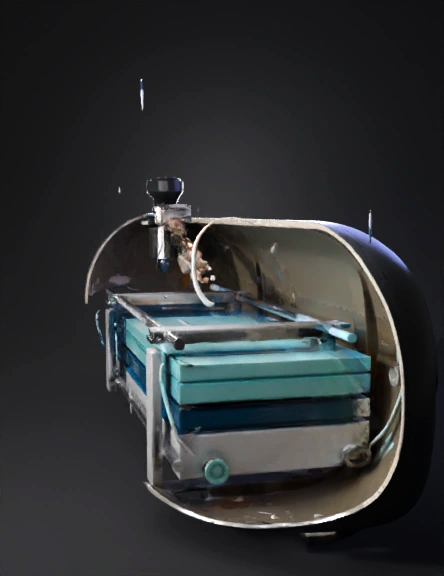
water purification tank 3d model
Tags
machine
machine realistic
machine rendering
machine rendering realistic
porosity
realistic
rendering
rendering realistic
Prompt
Title: Physics-optimized longitudinal cutaway of a next-gen water purification tank with composite media porosity visualization Goal: Create a jaw-dropping, photorealistic 3D visualization of a modern, never-before-seen water purification tank. The design must be grounded in physics to actively enhance water treatment efficiency. Show a full longitudinal cutaway, with internal composite media packs and their graded porosity visible in high detail. Include a lime (CaCO3/Ca(OH)2) micro-sprinkler dosing system at the top to reduce water acidity. The model should look like a real engineering prototype that investors and judges can trust. Composition & View: - Camera: isometric three-quarter view, subtly elevated, focusing on the interior longitudinal section. - Framing: complete tank visible with one clean cut along the length; show inflow/outflow, baffling, media packs, dosing unit, sensors, and sampling ports. - Exploded overlays: add discrete semi-transparent overlays for flow paths, reaction zones, and turbulence control (do NOT clutter; use clear visual hierarchy). - Labels: callouts with short, sharp captions; use clean micro-typography; keep label lines straight with minimal bends. Core Elements to Show: 1) Tank body: - Geometry: elliptical-rect hybrid cross-section for minimized dead zones and reduced wall-induced shear. - Material: composite shell (outer CFRP + inner chemically resistant liner). Show thin section thickness and ply orientation. - Structural features: internal ribbing aligned with flow direction to dampen vortices; vibration-isolated base mounts. 2) Inlet conditioning: - Swirl-canceling diffuser + laminarizing honeycomb to flatten velocity profile before media contact. - Integrated air release at inlet top to purge entrained gas without cavitation. 3) Lime dosing system (top): - Micro-sprinkler array with controlled droplet size (100–300 µm) for rapid mixing without local supersaturation. - Replaceable lime cartridge, sealed, with dose-rate control valve. - Show fine mist cone intersecting inflow, with a mixing baffle that promotes rapid neutralization. 4) Composite media packs: - Multi-layer cartridges with graded porosity (macro → meso → micro). - Layers: a) Pre-filter macro layer: 800–1200 µm pores (capture large particulates; low head loss). b) Transition layer: 200–500 µm pores (smooth pressure drop; prevent channeling). c) Reactive layer: mesoporous structure visualized (functionalized surfaces for hardness/metal adsorption). d) Polishing layer: 1–10 µm pores (final particulate removal; stable flow). - Visualize pore networks in the cutaway with color-coded porosity gradient. Avoid noisy micro-textures—keep readable. - Cartridge mounting: bayonet-style rails for quick swap, sealed gaskets, anti-bypass skirts. 5) Flow management: - Anti-channeling baffles guiding water evenly across each media pack. - Pressure equalization manifold; small bleed orifices indicated. - CFD-inspired smooth transitions, no sharp corners; minimal recirculation zones. 6) Sensors & access: - pH sensor before and after dosing. - Differential pressure sensors across media packs. - Sampling port after each stage. - Maintenance hatches: clearly sealed, tool-less quarter-turn locks. 7) Outlet & polishing: - Final laminar outlet chamber to minimize disturbance; anti-siphon check. - Optional UV module bay (leave placeholder geometry). Physics-driven benefits (visual cues): - Smooth, laminar flow entering media → uniform contact time. - Graded porosity prevents channeling and lowers head loss. - Fine mist lime dosing → rapid pH stabilization with minimal scaling. - Baffle geometry reduces turbulence intensity and recirculation. - Structural ribs align with flow vectors → lower vibrational energy transfer. Materials & Shaders: - Tank shell: matte CFRP weave with subtle anisotropy; inner liner: satin chemical-resistant polymer. - Media packs: semi-translucent composite with slight sub-surface scattering to reveal pore topology. - Lime mist: volumetric particles with soft bloom; not smoky. - Fasteners & rails: brushed stainless steel, light chamfers. Color & Visual Hierarchy: - Body: deep graphite; interior liner: light warm gray for contrast. - Porosity gradient: cool palette (dark blue = macro pores, cyan = meso, pale aqua = micro). - Flow path overlays: soft white/blue arrows; thin and minimal. - Sensor highlights: small amber accents for visibility. Lighting & Render: - Studio HDRI with soft key light (15° off-axis), clean rim light along cut edge, gentle fill to reveal interior. - Global illumination; mild bloom; physically-based rendering; high micro-detail without clutter. Annotations (short labels, vector style): - “Lime micro-sprinkler array (100–300 µm droplets)” - “Laminarizing honeycomb diffuser” - “Graded porosity media: macro → meso → micro” - “Anti-channeling baffles” - “pH pre/post sensors” - “Differential pressure taps” - “Sampling ports” - “Pressure equalization manifold” - “UV bay (optional)” - “Vibration-isolated base” Style: - Photoreal engineering visualization + subtle infographic overlays. - No cartoonish effects. No excessive bloom. Clean, premium, credible. Output: - Ultra-high-resolution 16:9 (7680×4320). - Main render + exploded cutaway inset of media cartridge (top-right). - Transparent background version and dark background version. Notes: - Maintain manufacturable geometry. Avoid visually confusing micro-details. - Keep labels concise and readable at 100% zoom. - Prioritize clarity of physics benefits over decorative complexity.
Detailed Info
Related Models
Enter invite code
Enter invite code to get credits!
 tahakanaani1387


 tahakanaani1387