3D Workspace
Home
Assets
Affiliate Program
Creator Program
Sign up/Log in
View Plans
DCC Bridge
lakshyaaddon
11-07 13:25
Model Name
algae bioreactor 3d model
Tags
algae
machine
machine realistic
machine rendering
machine rendering realistic
realistic
rendering
rendering realistic
Prompt
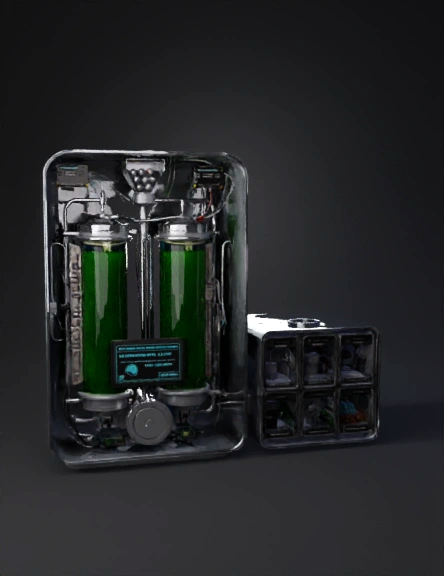
We have developed a comprehensive solution to address the issues outlined. This system provides oxygen in its natural, gaseous, and safe state. The apparatus consists of 152 litres of water and 1.4 kg of Chlorella Vulgaris. To enhance the growth and reduce the water requirement, Photo Bio Reactors are employed and are held in place by supporting frames. The addition of these reactors causes a drastic change in the water requirement, creating a positive impact on the design. Certain salts are infused in the water in specific quantities to support the growth of the algae. Sodium Nitrate (57 g per Photo Bio Reactor), Potassium Phosphate (1.42 g per Photo Bio Reactor), Calcium Chloride (1.37 g per Photo Bio Reactor) and Magnesium Sulphate (2.85 g per Photo Bio Reactor) and Ferric Citrate (0.23 g per Photo Bio Reactor) are the major nutrients to be included. These nutrients would be infused in the form of nutrient tablets. To infuse nutrient tablets into the Photo Bio Reactors, a centralized inlet unit is positioned at the top centre of the glass apparatus, shared by both Photo Bio Reactors. This unit consists of a tablet storage hopper connected to an electric linear actuator, which dispenses one tablet at a time. A Y-shaped diverter chute, controlled by a servo motor, directs each tablet into the appropriate PBR inlet through airtight tubing. The entire system is automated and controlled by the LEON chip, programmed to dispense these tablets at specific intervals. This setup ensures efficient and controlled nutrient delivery while maintaining the sealed environment of the apparatus. Multiplication of Chlorella Vulgaris can be managed by limiting nutrient requirements such as nitrogen and phosphorous. The implementation of the LED chips of Solistic LED light bulbs would be a beneficial upgrade to the AstroAlgae Synthesiser. These chips when affixed to a Flexible Printed Circuit Board (FPCB) mimics the original spectrum of the sun rays and when aligned to the wavelength of about 400 nm to 700 nm, it contributes significantly to the process of photosynthesis. The FCPBs are connected directly to the spacecraft’s main power bus, with the help of coils (transmitting coil and a receiving coil) along with a DC Circuit board, which receives power from a local power tap power in the spacecraft to facilitate more regulated voltage supply. A Lithium-Ion polymer battery would be positioned close to the receiving coil outside the Photo Bio Reactor. The power received by the receiving coil facilitates efficient charging of this battery. The battery would be connected to a battery management service (JBD 4S 12.8V 80A BMS) which prevents over-charging of the battery. With thermal management, this battery would be suitable for functioning by enduring extreme temperatures and radiation. The setup includes Gas Sensors positioned at the top right and left corners that regulate the levels of oxygen and carbon dioxide. The FireStingO2, optical luminescence-based oxygen sensors are employed in the top left corner of the apparatus. The sensor detects the presence of oxygen and triggers the opening and the closing of the sliding glass doors. For detecting carbon dioxide Senseair Sunrise, a non-dispersive infrared sensor will be put to use. These sensors shall be programmed to detect and display the oxygen production rate and rate of consumption of carbon dioxide on an LED screen affixed in the spacecraft as well as transmit the same information for record and research purposes on the Earth. The programming will be done with the help of a microcontroller (LEON, in particular). The LEON chip plays a dual role in this system. Not only does it facilitate the programming of the sensors (Language: C++), it also acts as a bridge between the sensor and the data bus. The data bus in use will be SpaceWire, that transmits the signal from the spacecraft to the earth. The LEON processor will already be embedded inside the On-board flight computer and will not require direct interface with chip. The apparatus is housed in a glass container featuring Permeable PDMS Membranes (bonded to the glass using plasma treatment) and sliding glass doors on the sides. The sliding of the glass doors will be facilitated by an electric linear actuator controlled with help of the LEON chip. The Photo Bioreactors will also be lined with PDMS gas membranes to prevent evaporation of water present in them. The sensors detect the oxygen produced, triggering the glass doors to open and facilitate the release of oxygen while simultaneously taking in carbon dioxide. This process maintains a continuous cycle. The system is equipped with temperature regulators that maintain a consistent temperature range of 25 to 30 degrees Celsius, optimal for both growth of the algae and photosynthesis. Two such apparatuses would be housed in the spacecraft, each apparatus consisting of 2 Photo Bio Reactors. Each Photo Bio Reactor consists of 260 g of the biomass of Chlorella Vulgaris in 38 l of water. These apparatuses will be in alternative use such that one of these functions to produce oxygen for the first 12 hours while the other is put to use in the next 12 hours. This helps in maintaining an efficient light cycle in the ratio 12:12, while allowing the algae to respire when the system is not in use. A unique feature of this project is that dead algae biomass is processed into capsules of size 1g each, that can be consumed as protein supplements. The dead biomass (approximately 78 g) is collected every 6 days and is processed into protein supplement capsules. This is done with the help of a food processing unit (about the same size of the oxygen production unit) which is connected to the main apparatus aided by the Silicone tubing (space-grade). The dead algae biomass loses density and settles at the bottom of the Photo Bio Reactor making it feasible to distinguish them from the living algal biomass. Additionally, to ensure accuracy, a laser based optical sensor specifically LK-G5001PV Laser Displacement Sensor would be placed at the bottom of the outer walls of the Photo Bio Reactor. This sensor measures the accumulated thickness of the dead biomass settled at the bottom of the Photo Bio Reactor. When the thickness reaches its threshold point (i.e. sediment >/= 1 cm), it triggers the LEON chip to open the Solenoid Valve 12V responsible for releasing these dead algae cells into the silicon tubing that leads it into the Food Processing Unit. This valve is interfaced with the LEON chip using a transistor (IRLZ44N in specific) mounted on a driver board located close to the Solenoid. Once the LEON chip sends signals to the transistor, it assists in safely providing the required voltage and current by the Solenoid valve, facilitating the opening and closing of the valve. Once the dead algae pass through the valve, it is pushed by a peristaltic pump inside the silicon tubing to the Food Processing Unit. The Food Processing Unit is further divided into 8 chambers (four on top and four below) – Intake chamber, Ultrasonic Disruptor chamber, Dehydration chamber, UV Sterilization chamber, Empty Capsules Storage chamber, Forming chamber, Storage chamber and the Dispensing chamber. The biomass slurry enters the first compartment of the Food Processing Unit, the Intake chamber through the silicon tubing. An ultrasonic level sensor (MaxBotix MB7389 in specific) is mounted at the top centre of the chamber and is integrated with the LEON chip. When the filling point of the chamber reaches 80% approximately, the slurry is transferred through an outlet pipe (silicon tubing) into the filtration unit. A peristaltic pump pushes the slurry through the tubing and the flow is controlled by a solenoid valve to prevent backflow. The second chamber consists of a Homogenizer (a mini ultrasonic disruptor) and a borosilicate beaker both affixed to the chamber. The device emits high-frequency sound waves (typically between 20 kHz and 40 kHz). These waves propagate through the biomass slurry (algae mixed with a small amount of water). These sound waves cause microscopic bubbles to form and rapidly collapse in the liquid—a process called cavitation. The collapse of these bubbles produces intense local pressure and shear forces. The shear forces and shockwaves physically break the cell walls and membranes of the algae. This releases the cell’s contents (like proteins, lipids, vitamins) into the surrounding medium. The cavitation effect also helps remove dirt, unwanted biofilms, and surface contaminants from the biomass. A peristaltic pump and solenoid are put to use to facilitate smooth transfer of the slurry to the Dehydration chamber. This chamber houses temperature controlling sensors (VETENG High-Precision NTC Thermistor, which measures the temperature inside the chamber and Cole-Parmer Benchtop PID, which controls the temperature based on the inputs received and placed outside the chamber) which regulate the temperature between 35 to 40 degrees Celsius specifically for this chamber. A vacuum pump is placed on top of the chamber and is connected to the chamber via a vacuum pipe (made out of stainless steel). This vacuum line is an airtight tubing that allows vapor to be pulled out from the chamber and helps in dehydration. A moisture sensor (Dryer Master 2220 Series) would be in contact with the biomass and when the moisture content </= 5%, it will, by means of the LEON chip, trigger the solenoid valve placed in the outlet pipe to open. The biomass is pushed via the electric linear actuator into the outlet pipe which then passes on to the UV Sterilization unit. This chamber consists of LED chips of UV-C with peak emission at 265 nm affixed to thin strips of metal-core FPCB (Flexible Printed Circuit Board). These strips, attached to the top and sides of the container provide even distribution of UV-C for germicide. A UV Dosimeter sensor (Apogee SU-100) is also a part of the chamber. This measures UV dose in real time and automates shutoff when 30–40 mJ/cm² is reached. It also triggers the functioning of the electric linear actuator and two solenoid valves (one at the initial point of the outlet and another near the forming chamber), transferring the biomass directly into the Forming Chamber. The fifth chamber is solely responsible for storing empty capsules and pushing them one at a time onto the capsule holder in the Forming chamber with the help of a stepper motor with the assistance of the LEON chip. The set up in the Forming chamber consists of the Piezoelectric Micro-Dispenser, which dispenses the powdered biomass into the empty capsule. It is situated and fixed at the top of the chamber, with its nozzle faced directly towards the capsule holder (borosilicate slide). The capsule holder is placed on a miniature load cell (Rudrra Miniature Load Cell). The load cell measures the powdered biomass that enters the capsule. When 1g of the powdered biomass enters the capsule, it triggers the solenoid valve, near the forming chamber to close when it reaches capacity. A Micro Piston is fixed on the side walls of the chamber slightly above the capsule holder which is used to seal the capsule once filled and pushes it forward to the Storage chamber. The Storage chamber also consists of a stepper motor, programmed to dispense one capsule at a time on pressing the button (coded with the help of the LEON chip) fixed next to the Food Processing Unit. The front door of the chamber is a sliding door which opens as a response to the pressing of the button which can then be consumed. To wirelessly power and control all sensors, solenoids, pumps, and actuators within the sealed glass AstroAlgae Synthesiser, a compact wireless power transmission system using XKT-412 coils is employed, drawing regulated power from the spacecraft’s local power tap. The wireless power receiver coil is positioned at the center bottom of the apparatus, capturing power transmitted from the spacecraft’s local power tap. The received voltage is fed into an LM2596 step-down converter, which regulates the voltage to a safe, stable level for the system. This regulated power is then supplied to the ESP32 microcontroller, driver boards equipped with IRLZ44N transistors, and all connected components such as sensors, solenoid valves, pumps, and actuators. The driver boards with transistors help safely control and switch higher current loads in the system. An NRF24L01+ transceiver module is integrated with the ESP32 to enable wireless communication between different units and the spacecraft’s main control system, ensuring efficient operation and data exchange across the oxygen production and food processing apparatus
Detailed Info
Related Models
Enter invite code
Enter invite code to get credits!
 lakshyaaddon


 lakshyaaddon