3D Workspace
Home
Assets
Affiliate Program
Sign up/Log in
?
Upgrade
DCC Bridge
3D Creation Made Simple
Text & Image to 3D Model in seconds
One-Click Texturing & Smart Detail Editing
Free Credits Monthly
Start Free
Anonymous1762327697
11-05 07:30
Model Name
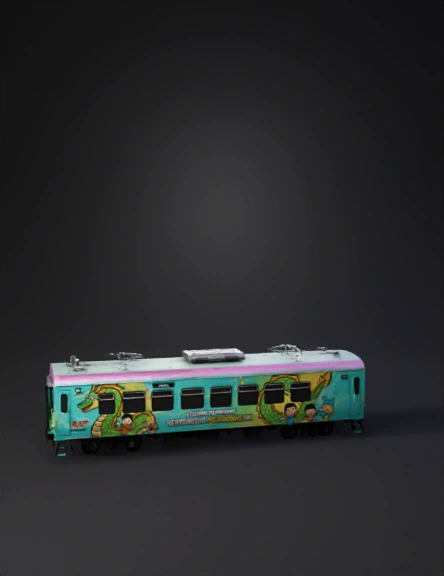
kereta api eksekutif 3d model
Tags
vehicle
rendering
realistic
Prompt
KAI Eksekutif Coach Livery I. Subject and Context – The Core Model The goal is to generate an ultra-realistic, high-fidelity 3D model of a single, modern Indonesian KAI (Kereta Api Indonesia) Eksekutif Class (Executive Class) passenger train carriage (coach). This is not a simplified or low-poly model; it must be suitable for close-up rendering and animation. The carriage should be modeled as if it were parked on a track section, viewed from a side profile, similar to the reference image. The primary objective is the faithful and detailed reproduction of the unique, colorful, limited-edition livery (decal wrap) applied to the coach's body. The model should represent a typical Indonesian Kereta Ekonomi Plus or Eksekutif stainless steel-bodied coach, likely of the K1 type, recognizable by its modern, rounded profile and distinct window configuration. Focus on rendering one complete side of the carriage, ensuring all details are present from the coupler interface (implied cut-off) to the end of the coach. The overall scale and proportions must be accurate to real-world rail standards (standard gauge). II. Primary Structure and Geometry The fundamental structure of the carriage is a silver-grey/light stainless steel box-shape with a gentle curve at the roofline and floor edges. * Roofline: The roof should have a subtle gradient of green/cyan fading into magenta/purple near the top edge, consistent with the graphical background surrounding the train in the source image. This color application should be interpreted as a subtle, soft airbrush effect on the roof/upper side panel transition. The actual roof hardware, including the central air conditioning units/vents and the base plates for the pantographs (if applicable, though often these coaches are unpowered), must be accurately modeled with a darker grey or black finish, showing bolted connections and surface texture. * Window Band: There are seven large, rectangular, slightly tinted windows. The entire window band, from the first window to the last, serves as the canvas for the main decal. The windows themselves should exhibit a subtle reflective quality without being completely transparent, suggesting tinted glass. * Undercarriage (Bogies): Crucial for realism are the two sets of three-axle bogies (wheel sets) positioned beneath the coach. These must be modeled in detail, showing springs, brake rigging, and the wheels themselves. The bogies and undercarriage equipment (air tanks, battery boxes, various piping) should be rendered in a dull black or rusty-brown color, suggesting heavy use and exposure to the elements. * Doors: The model must include the detailed access doors on the ends of the coach body (visible on both left and right sides of the image). These doors should have appropriate handles and locking mechanisms. III. Decorative Livery (Decal) Details This section is paramount. The decal is the most distinctive feature and covers the entire side panel, wrapping around the windows. * Base Graphic: The background of the livery is a vibrant, abstract blend of cyan, yellow, and green, specifically behind the central text. * Serpentine Motif: A bold, stylized serpentine (dragon-like) element dominates the decal. This creature is primarily colored in bright green, yellow, and orange, with black outlines for definition. It wraps dynamically around the windows and the central text. Pay close attention to the head of the creature on the far left, which appears friendly and stylized. The tail section extends toward the right. * Cartoon Characters: Several stylized, cheerful cartoon characters are placed along the lower edge of the decal. These characters include children and a few anthropomorphic figures (e.g., a small green creature/spirit), all rendered in a clean, flat-color style with thick black outlines (akin to modern animation or sticker art). Their placement is critical: one group on the left near the KAI logo, and another group on the far right. They are interacting with the serpentine motif. IV. Text, Logos, and Typography The text must be sharp and legible, using the correct fonts where possible. * Primary Slogan (Center): The large, dominating text in the center is "BERSAMA MENYAMBUNG SILATURAHMI". The text is white and yellow, with a dynamic perspective that follows the curve of the serpent and the window band. The word "BERSAMA" and the start of "MENYAMBUNG" are slightly smaller and lead into the large, emphasized words "SILATURAHMI," suggesting connection and unity. * KAI Eksekutif Logo: The official KAI logo (a simplified wing or arrow motif in red and white) must be present on the far left of the carriage. Below it, the word "Eksekutif" is written in a distinct, clean sans-serif font. * Route Name Box: A small, black, rectangular name box is positioned above the central window. It contains the route name "SEMERU" in clear, white capital letters. * Small Print: Include the small, almost illegible text seen below the windows and adjacent to the main slogan, simulating operational markings or sponsor details, rendered in white or light grey. V. Materials and Textures The realism of the model hinges on the material properties: * Base Carriage Body: The silver-grey body should have a matte to subtle satin finish, simulating either painted metal or stainless steel, with slight variations and subtle dirt/grime accumulation, particularly around the vents and lower panels, avoiding an overly pristine look. * Decal Livery: The livery should have a semi-gloss finish, distinct from the base metal, simulating a large vinyl wrap. The edges of the wrap should be visible only upon close inspection, not perfectly blended. * Windows: Dark, tinted glass with a low opacity and a visible reflection of the environment. * Wear and Tear: Introduce slight imperfections: subtle dust streaking down from the roof units, minor scuff marks on the lower skirt, and the dull, textured look of worn rubber seals around the windows. VI. Lighting, Camera, and Style The final rendering should present the model in a way that maximizes the visibility of the livery. * Lighting: Use bright, even daylight lighting (high noon or slightly overcast) to eliminate harsh shadows and ensure the colors of the decal are accurately represented. A subtle, directional light source should define the 3D geometry. * Camera: A side-on, orthogonal or slightly perspective view that captures the entire length of the coach, mirroring the reference image. The background should be a simple, soft gradient of green/cyan to magenta/purple, exactly as depicted in the source image, isolating the train itself. * Style: The final output must be photorealistic (realistic render, V-Ray, Arnold quality) while maintaining the clean, stylized vibrancy of the cartoon art on the decal.
Detailed Info
Related Models
Enter invite code
Enter invite code to get credits!
Expires in: 00:00:00