3D Workspace
Home
Assets
Affiliate Program
Sign up/Log in
?
Upgrade
DCC Bridge
Anonymous1762449713
11-07 00:22
Model Name
doll head 3d model
Tags
3d printing
3d printing clay
character
character 3d printing
character 3d printing clay
character clay
clay
doll head
toy
Input
Prompt
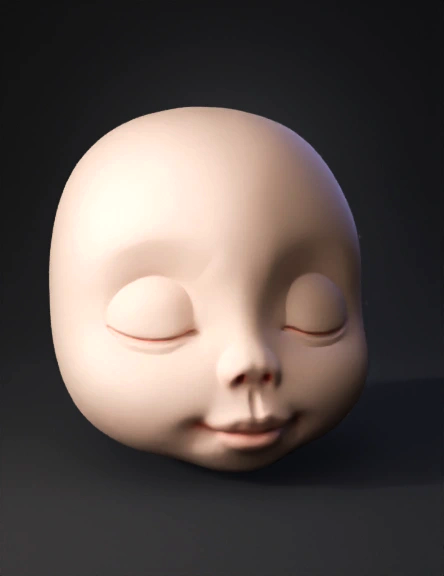
Fig. 1: Example of a smooth sculpted doll face (closed eyelids, defined features). The doll head should have a broad forehead, full rounded cheeks, and a gently tapered chin – a classic “doll” silhouette americangirl.fandom.com adelepo.com . Eyes are sculpted closed or barely open (no iris/pupil), creating a serene look. The nose is small with a smooth bridge and fine nostrils; sculpting guides even suggest adding clay to form a clear nose bridge and gently pressing in the nostrils adelepo.com cdhm.org . Lips are soft and symmetrical with a pronounced Cupid’s bow and subtle philtrum – artists “press up at an angle on the inside of the top lip” and “draw in the philtrum” to define these details cdhm.org . Crucially, all facial planes are blended so the surface is very smooth and matte. For example, one clay-sculpting tutorial advises sanding the dried sculpture “to the smooth finish” adelepo.com . This ensures a clean, balanced head geometry with clear landmarks but no distracting texture – ideal for silicone molds or polymer-clay casting. Key Face Features (as Sculpted) Head shape: Wide, domed forehead; rounded, full cheeks; a delicate tapering toward a slightly pointed chin americangirl.fandom.com adelepo.com . These proportions create a youthful, stylized look. Eyes: Sculpted lids only (eyes closed or nearly closed) with no painted eyelashes or pupils. The example above shows very simple eyelid forms with smooth transitions. Nose & Bridge: A gentle, centrally placed nose bridge. Tutorials recommend forming a nose bridge by smoothing clay between the eyes, then using a tool to press in fine nostrils adelepo.com cdhm.org . The overall nose is small and blends softly into the cheeks. Mouth & Philtrum: Soft, even lips with a well-defined Cupid’s bow. The cupid’s bow is created by pressing up on the inner top-lip clay, and the philtrum (vertical groove) is lightly etched in with a stylus cdhm.org . The corners of the mouth are gentle without hard edges. Surface quality: All curves and transitions are very smooth. As one doll-sculpt guide notes, the final clay head is typically “sanded… to the smooth finish” adelepo.com . This yields a matte, featureless skin surface (no pores or texture), so that the printed or cast model will look uniform under neutral lighting. From 2D Image to 3D Model Single-view reconstruction: Recent neural methods can infer a full 3D head from one photo. For example, NVIDIA’s Live3D approach uses an encoder and neural radiance field (NeRF) to lift a single face image into a 3D mesh in real-time research.nvidia.com . Such methods can automatically generate a plausible doll-head geometry (though they may need style guidance for non-realistic proportions). Text-guided 3D synthesis: A powerful option is a text-to-3D diffusion pipeline (e.g. DreamFusion). One describes the doll head in words (as above) and the system optimizes a 3D mesh so that its rendered views match the description. Notably, DreamFusion uses a pretrained 2D diffusion model as a prior to sculpt a 3D NeRF, requiring no 3D training data arxiv.org . In practice, one would write a prompt listing the features (wide forehead, closed eyelids, etc.) and let the model converge to a consistent 3D shape. Manual or hybrid modeling: Alternatively, one can import the photo into a 3D sculpting program (Blender, ZBrush). Using the image for reference, the artist sculpts a symmetrical head mesh with the above proportions. This approach ensures precise control of features and makes it easy to enforce the closed-eyelid, no-hair requirements. Technical considerations: Ensure the final mesh is watertight and has no extraneous geometry (remove the neck so only the head remains). Symmetry is critical – use mirroring tools so left/right features match exactly. The surface should be clean (no internal faces or self-intersections) and saved at high resolution so fine curves (philtrum, lip ridge) are smooth. This prepares the model for 3D printing or mold-making. Finishing Touches Once the head shape is captured, finalize it for casting. Apply a smoothing operation or subdivision so that all surfaces appear as soft matte clay (no shine or noise). Check symmetry by comparing left/right features in orthographic views. If using a sculpting program, one might bake or export a high-poly mesh and then remesh it to a cleaner topology suitable for printing. Finally, render the model in neutral, diffuse lighting against a plain background (as a product-style preview), to verify it meets the reference style. Example Prompt (for a generative model): “High-resolution 3D model of a stylized doll head. The head has a wide, smooth forehead, very rounded cheeks, and a delicate tapered chin. Eyes are closed with smooth sculpted lids (no irises or pupils). The nose is small with a subtle, well-defined bridge and fine nostrils. Lips are soft and symmetrical with a clear Cupid’s bow and slight philtrum. No hair, eyelashes, or eyebrows are present. The surface is smooth and matte like polymer clay. Symmetric, neutral lighting on a plain background.” Sources: Facial sculpting guides and 3D modeling research were consulted to define the proportions and methods americangirl.fandom.com adelepo.com cdhm.org research.nvidia.com arxiv.org . These sources detail typical doll face features and modern techniques for single-image 3D reconstruction.
Detailed Info
Related Models
Enter invite code
Enter invite code to get credits!
 Anonymous1762449713


 Anonymous1762449713